XRP Used as Settlement Layer in Landmark Tokenized U.S. Treasury Deal
XRP just settled tokenized U.S. Treasuries across borders and banks in under 5 seconds. Ondo Finance, J.P. Morgan's Kinexys, Mastercard, and Ripple pulled off a financial first — and it changes what 24/7 global settlement could look like.
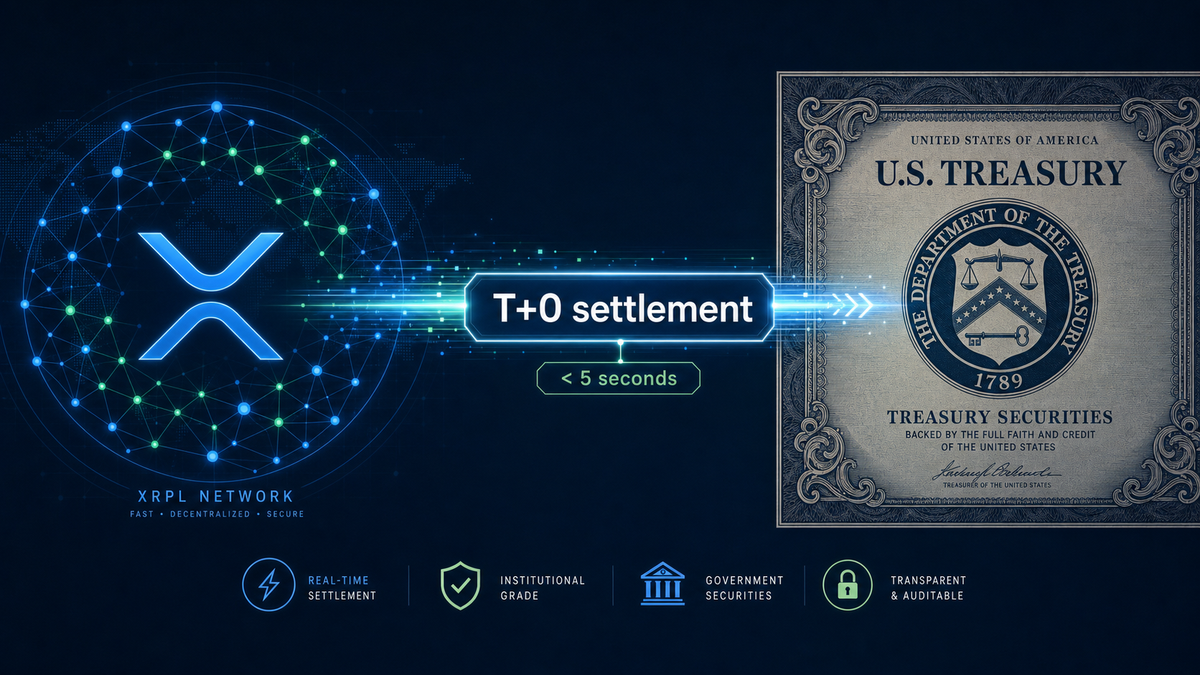
Ondo Finance, J.P. Morgan, Mastercard, and Ripple Complete the First Cross-Border, Cross-Bank Tokenized Treasury Redemption in History
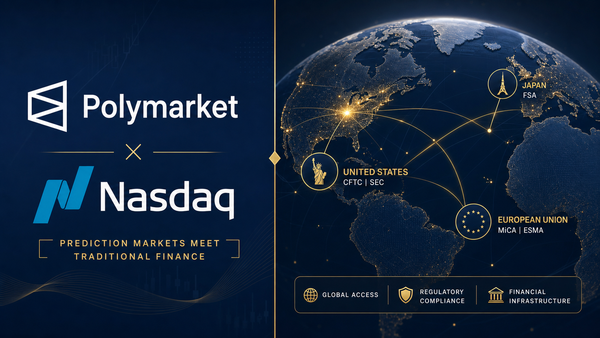
On May 6, 2026, four of the most influential names in global finance made history. Ondo Finance, working alongside Kinexys by J.P. Morgan, Mastercard, and Ripple, pulled off the first near real-time, cross-border, cross-bank redemption of a tokenized U.S. Treasury fund — with the XRP Ledger at the center of it.
No whitepaper. No roadmap. It happened.
What Actually Happened
The pilot established a framework for 24/7, near real-time cross-border settlement across global banks for tokenized asset redemption.
The transaction flow, confirmed by the official press release:
- Ripple redeemed a portion of its holdings in Ondo's tokenized short-term U.S. Government Treasury product, OUSG, on the XRP Ledger — a public blockchain.
- The on-chain asset leg settled in under five seconds.
- Ondo routed a fiat payout instruction through Mastercard's Multi-Token Network (MTN), which passed it along to Kinexys by J.P. Morgan.
- Kinexys debited Ondo's Blockchain Deposit Account and pushed U.S. dollars cross-border to Ripple's bank account in Singapore via J.P. Morgan's correspondent banking rails.
- The whole thing completed in near real time, within the same minute, and outside traditional banking cutoff windows.
That split is the core of what makes this notable: public-chain settlement speed tied to bank-account completion, while the USD payout stayed on bank infrastructure.
Why This Matters
To appreciate the significance, think about how international settlements have worked for decades. Cross-border transactions between banks in different countries typically take one to three business days. Time zones, banking hours, and generations-old correspondent relationships all slow things down. Transactions that need to settle outside those windows often just wait — sometimes an entire weekend.
As Ondo Finance President Ian De Bode put it: "By connecting public blockchain infrastructure with interbank settlement rails, Ondo, Kinexys by J.P. Morgan, Mastercard, and Ripple are laying the groundwork for 24/7 global markets that never close."
For institutions managing liquidity across time zones — hedge funds, asset managers, multinationals — even a few hours of settlement lag translates directly into capital inefficiency.
The pilot also introduced a consolidated model where token redemption automatically kicks off the fiat settlement process, with no additional manual instructions required. That automation strips out the reconciliation steps and back-and-forth messaging that still define most interbank settlements today.
And the architecture isn't limited to Treasuries. The framework supports redemptions from any public blockchain on which OUSG is issued, making this plumbing extensible across asset classes and networks.
The Institutions Behind It
Every participant here operates at real institutional scale — this wasn't a startup sandbox test.
Kinexys by J.P. Morgan has processed more than $3 trillion in transactions since inception and averages more than $5 billion in daily transaction volume.
Mastercard's Multi-Token Network (MTN) served as the interoperability layer, letting regulated financial institutions connect to blockchain commerce without abandoning their existing infrastructure.
Ondo Finance alone has $323 million in tokenized U.S. Treasury products on the XRP Ledger.
And from Ripple's side, Markus Infanger, SVP of RippleX, said: "The XRP Ledger enables real-time asset movement, and when paired with global banking infrastructure, this pilot shows how institutions can execute cross-border transactions as a single, integrated flow."
The Bigger Picture: Tokenized Treasuries Are No Longer a Niche
This pilot lands during a moment when real-world asset tokenization is moving from experiment to institutional norm — fast.
As of mid-May 2026, the total value of tokenized U.S. Treasuries tracked by RWA.xyz sits at approximately $15.49 billion.
The broader tokenized RWA market hit $34.5 billion in May 2026, up over 100% year-on-year. Standard Chartered projects that the number could reach $30 trillion by 2034.
The traditional settlement cycle for U.S. Treasuries is T+1. On-chain, it's effectively instant. When a fund tokenizes its Treasury holdings, those assets can be used as collateral, traded 24/7, and settled in minutes rather than days. For institutions managing billions in liquidity, that's not a minor convenience.
The Ondo/Ripple/J.P. Morgan/Mastercard pilot proved exactly that — live, cross-border, between real institutions, with real dollars.
XRP and Ripple: What This Means
Institutional Validation of the XRP Ledger
The choice of XRPL as the public blockchain isn't incidental. Ripple wasn't just a participant — it was the counterparty redeeming the asset. The ledger was the execution layer for the on-chain leg of a transaction that involved J.P. Morgan correspondent rails, Mastercard's network, and a tokenized U.S. government security. That's a meaningful credential.
The XRP Ledger crossed $3 billion in tokenized real-world assets as of late April 2026, a 59% jump in just 30 days. Beyond Ondo's Treasury products, assets being tokenized on XRPL include real estate instruments, commodity-backed tokens, and stable-value assets.
U.S. Treasury products on the network have grown from $50 million in 2025 to more than $418 million in 2026 — an 8x increase in a year.
XRPL's Technical Edge
The XRP Ledger is a public layer-1 blockchain built for the creation, transfer, and exchange of digital assets, with over 12 years of uptime and more than $1 trillion processed. Transactions settle in seconds for less than a cent.
That performance profile — sub-5-second finality, sub-cent fees — is what made XRPL a viable public chain for a transaction of this weight.
On XRP Price: Be Realistic
Infrastructure wins and token price don't always move together, and it's worth being straight about that. Institutions are choosing XRPL for its infrastructure, not for XRP as an asset. Settlements often happen in stablecoins like RLUSD, and the only XRP institutions need is for transaction fees, which run a fraction of a cent.
All XRPL transactions do burn a small amount of XRP permanently, so as institutional volume grows, the supply does become gradually more scarce. But at current transaction volumes, the fee burn alone isn't a meaningful near-term price driver.
The longer-term bull case for XRP runs through Ripple's On-Demand Liquidity product and the potential for XRPL to become a hub for cross-chain RWA settlement as volumes scale. Ripple's CTO, David Schwartz, has noted that XRPL's built-in decentralized exchange enables seamless token conversions, with XRP often serving as the intermediary asset. That's a structural story, not a short-term one.
What This Means for Ripple's Business
Beyond the token, this pilot hands Ripple a powerful proof point for its enterprise business. Every bank, asset manager, or fintech evaluating tokenized asset infrastructure now has a live, real-dollar example to study — one that featured J.P. Morgan, Mastercard, and a cross-border settlement to Singapore. That's a hard thing to replicate on a slide deck.
Archax has committed to bringing $1 billion in additional assets onto the ledger by mid-2026. Société Générale launched its euro stablecoin on XRPL in February, Aviva Investors announced a tokenization partnership with Ripple, and Deutsche Bank integrated Ripple's technology for cross-border payments.
Market Implications
The ripple effects — no pun intended — extend well beyond XRP:
For global banks: A working template now exists for tokenized asset redemption that runs outside banking hours, across borders, across institutions. Banks sitting on the sidelines have a tested architecture to evaluate.
For asset managers: Tokenized Treasury products let capital stay in the on-chain ecosystem while rotating into a safer yield product — no need to fully exit digital markets to lower risk.
For the DeFi/TradFi convergence: This pilot is the clearest live demonstration yet that public blockchain rails and institutional banking infrastructure can function as a single coordinated system — not competitors, but complements.
For the long-term outlook: Standard Chartered projects the tokenized asset market at $30 trillion by 2034, while Ripple and Boston Consulting Group put the estimate around $18.9 trillion by 2033.
Key Takeaways
- On May 6, 2026, Ondo Finance, Kinexys by J.P. Morgan, Mastercard, and Ripple completed the first cross-border, cross-bank, near real-time redemption of a tokenized U.S. Treasury fund in history.
- The XRP Ledger settled the on-chain leg in under five seconds. Fiat settlement followed via Mastercard MTN, Kinexys, and J.P. Morgan's correspondent banking rails — outside traditional banking hours.
- The tokenized U.S. Treasury market now exceeds $15.49 billion. The total tokenized RWA market has surpassed $34.5 billion as of May 2026.
- This establishes a replicable framework for 24/7 institutional tokenized asset settlement across borders and banks.
- For Ripple, it validates XRPL as a serious institutional infrastructure. For XRP as a token, the connection between infrastructure adoption and price is a longer-term structural story tied to volume and ODL usage — not a short-term catalyst.
The gap between blockchain and traditional finance isn't just narrowing. In this case, for five seconds, it didn't exist at all.
DISCLAIMER: This newsletter is for informational purposes only and does not constitute investment advice, advertising, or a recommendation to buy, sell, or hold any securities. This content is not sponsored by or affiliated with any of the mentioned entities. Investments in cryptocurrencies or other financial assets carry significant risks, including the potential for total loss, extreme volatility, and regulatory uncertainty. Past performance is not indicative of future results. Always consult a qualified financial professional and conduct thorough research before making any investment decisions.