A Historic Week for Crypto Law: CBDC Banned, Stablecoin Yield Rules Drop
The Senate banned the Fed's digital dollar until 2030 — and the CLARITY Act's stablecoin yield text just went public. Passive yield is out. Activity rewards barely survived. Markup targeted for May 11. Here's what it all means.
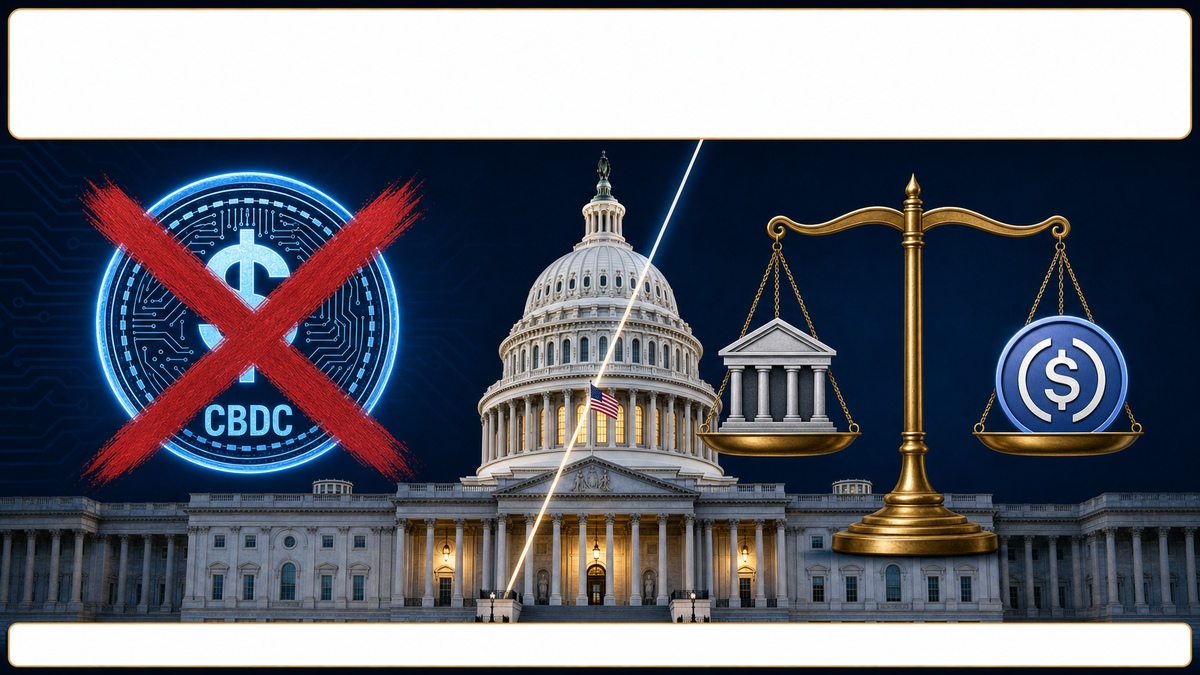
The Senate has blocked the digital dollar, the CLARITY Act's yield compromise text is now public, and the markup clock is ticking. Here's what it all means.
Two significant developments are reshaping the U.S. crypto regulatory landscape in real time. First: the Senate passed — with an overwhelming 89-10 bipartisan vote — a provision banning the Federal Reserve from creating a central bank digital currency (CBDC) until at least December 31, 2030. Second: the full text of the CLARITY Act's stablecoin yield compromise — Section 404, authored by Senators Thom Tillis (R-NC) and Angela Alsobrooks (D-MD) — dropped publicly on May 1, confirming the framework that crypto and banking interests have been fighting over for months. Passive yield on stablecoins is banned. Activity-based rewards survive, narrowly. A Senate Banking Committee markup is now expected as soon as the week of May 11. Together, these two developments represent the most consequential stretch in U.S. crypto policy since the GENIUS Act was signed into law in July 2025.
The CBDC Ban: Senate Moves to Block the Digital Dollar
In March 2026, the U.S. Senate voted 89-10 to pass the 21st Century ROAD to Housing Act — a sweeping housing supply bill — with a notable crypto rider attached to its final pages: a prohibition on the Federal Reserve issuing a central bank digital currency until at least the end of 2030.
The legislation states that the Federal Reserve System may not issue or create a central bank digital currency or any digital asset substantially similar to one, directly or indirectly through a financial institution or other intermediary. The provision includes a sunset date of December 31, 2030, and carves out an exception for private, permissionless, dollar-denominated digital currencies that fully preserve the privacy protections of physical currency. The White House published a Statement of Administration Policy explicitly supporting the CBDC provision — backing what has long been a Republican legislative priority and a core concern for crypto advocates who fear government surveillance of financial transactions.
A CBDC is distinct from a stablecoin. Where stablecoins like USDC or USDT are issued by private companies, a government-issued digital dollar would be controlled directly by the Federal Reserve. Critics argue this would give the government unprecedented transaction-level visibility into everyday spending.
Blockchain Association CEO Summer Mersinger stated that "a government-issued CBDC would threaten core American values — financial privacy, civil liberties, and limits on state power — by giving the government unprecedented insight into (and potential leverage over) everyday transactions."
Digital Chamber CEO Cody Carbone called the Senate vote a positive step, saying that "financial privacy is a cornerstone of American freedom" and that digital innovation in the U.S. "should be led by the private sector."
What's still unresolved: The CBDC ban has not yet become law. The 21st Century ROAD to Housing Act still requires passage in the House of Representatives, where lawmakers have signaled they may push back — particularly on a separate provision limiting large investor ownership of homes. President Trump has also stated he will not sign any legislation until Congress passes a voter-ID law, adding another layer of political uncertainty to the timeline.
Despite that uncertainty, the 89-10 vote signals that CBDC prohibition has genuine, durable bipartisan support — and the provision is also already embedded in the CLARITY Act's own short title, the "Anti-CBDC Surveillance State Act," meaning it could ultimately reach the president's desk through multiple legislative vehicles.
Section 404 Drops: What the CLARITY Act's Yield Compromise Actually Says
The more immediately pressing development landed May 1, when Alex Thorn of Galaxy Digital confirmed the public release of Section 404 of the CLARITY Act — the formal legislative text codifying the Tillis-Alsobrooks stablecoin yield compromise that has been the central battleground of crypto policy negotiations since January.
The section is titled "Prohibiting Interest and Yield on Payment Stablecoins," and it is precisely what the banking industry lobbied for: a broad prohibition on passive yield, with a narrowly defined carve-out for activity-based rewards.
What's prohibited: Digital asset service providers — including exchanges, brokers, and affiliated entities — are prohibited from offering yield directly or indirectly on stablecoin balances, or in any manner that is economically or functionally equivalent to bank interest. The prohibition is broad by design, closing workarounds through affiliates and structuring arrangements.
What's still allowed: The bill permits rewards tied to genuine user activity — not passive balance-holding. Specifically permissible are incentives tied to completing payments, transfers, or settlements involving a stablecoin; providing liquidity in market-making or trading contexts; and actively using products or services, including governance participation or loyalty programs based on real, documented actions. The SEC, CFTC, and Treasury are jointly directed to issue regulations within 12 months of enactment defining exactly which reward programs qualify and publishing anti-evasion rules.
The staking gray area: One notable ambiguity left in the text is the treatment of staking-based rewards. The bill does not define staking, leaving its legality under the activity-based reward carve-out unclear. The debate has centered on Coinbase seeking to offer activity-based rewards while the banking industry objects specifically to staking — with the final call effectively deferred to the OCC under the current administration's crypto-friendly regulatory posture.
Why the Banking Industry Won This Round
The stablecoin yield fight has been one of the defining regulatory battles of 2026, and the released text tilts clearly toward the banking industry's position — though not without a fight that stretched across months and multiple White House interventions.
Standard Chartered analysts estimated that a yield provision, if enacted, could redirect up to $500 billion in deposits from traditional banks toward stablecoin products by 2028 — a number that explains the intensity of the banking industry's opposition. This was never a regulatory preference; it was an existential commercial calculation.
The American Bankers Association formally rejected a White House compromise in March that would have allowed yield in limited peer-to-peer contexts while prohibiting it on idle balances — resetting negotiations entirely. The text released today lands closer to the banking industry's position than that White House compromise.
Coinbase, which earns roughly one-fifth of its revenue from offering rewards to stablecoin holders on its platform, had pulled its support for the bill at the eleventh hour in January — forcing the Senate Banking Committee to cancel its markup with hours to spare. The exchange reversed course in April and backed the current version, though it has continued to flag concerns about the precise scope of the activity-based carve-out and how regulators will define it.
White House crypto adviser Patrick Witt made no effort to conceal his frustration with the banking industry's prolonged resistance. Witt posted publicly on X: "It's hard to explain any further lobbying by banks on this issue as motivated by anything other than greed or ignorance. Move on."
Senator Alsobrooks, in remarks to an American Bankers Association summit, framed the compromise as one designed to "prevent deposit flight" — underscoring that the banking industry's core concern about protecting the traditional deposit model was ultimately reflected in the final language.
The Markup Window: May 11 or Bust
The public release of Section 404 is the mandatory first step before any Senate Banking Committee markup can proceed — members must have access to the text before voting on it. The question now is whether Chairman Tim Scott will schedule that markup for the week of May 11, as Senator Tillis has urged.
Tillis told reporters on April 29 that the CLARITY Act has "addressed a lot of the concerns" from banking lobbyists and said he intends to encourage the chair to move forward with a markup — also welcoming bankers to continue negotiations, noting "there may be a few more that we can get there, if they want to come and work in good faith."
The timeline pressure is severe. Alex Thorn of Galaxy Digital warned that the CLARITY Act has a roughly 50-50 chance of becoming law in 2026, and possibly lower, stating: "If the markup slips past mid-May, the probability of enactment in 2026 will drop sharply."
Galaxy outlined five sequential hurdles the bill must still clear: a Senate Banking Committee markup, a 60-vote Senate floor threshold, reconciliation with the Senate Agriculture Committee's version, reconciliation with the House-passed CLARITY Act from July 2025, and a presidential signature. Polymarket currently prices passage at approximately 47%, down from 82% in February.
Beyond stablecoin yield, unresolved issues remain. Senator Chuck Grassley has signaled that DeFi-related legal protections in the bill may need to route through his Judiciary Committee — a potential additional delay. Ethics provisions restricting senior government officials from profiting off crypto holdings while in office remain live and could complicate the Senate floor vote where 60 votes are required.
Senator Bernie Moreno stated publicly earlier this year that if crypto legislation does not pass in May, it won't happen for the "foreseeable future" — a sentiment shared across much of the industry, with midterm election season set to consume the congressional calendar as summer approaches.
What This Means for the Broader Crypto Market
Both developments — taken together — send a clear directional signal from Washington: the U.S. government is moving to explicitly favor private-sector digital assets over government-controlled alternatives, while simultaneously drawing firmer lines around how those private assets can be monetized.
The CBDC ban clears the runway for private stablecoin issuers by eliminating any near-term threat of a government-issued competitor. With the Federal Reserve sidelined from issuing a digital dollar until at least 2030, companies like Circle (USDC) and Tether (USDT) face no government competition for the foreseeable future — a meaningful tailwind as global stablecoin adoption accelerates.
The Section 404 yield framework, however, represents a real constraint for crypto platforms whose business models were built around stablecoin reward programs. Platforms will need to restructure how they incentivize users — shifting from balance-based rewards toward transaction and activity-based models. The 12-month rulemaking window the bill creates means that legal clarity on exactly what's permissible won't arrive quickly.
JPMorgan analysts have publicly described CLARITY Act passage by midyear as a positive catalyst for digital assets broadly — a view that reflects how much institutional deployment in crypto is currently gated behind regulatory clarity. The next two weeks will begin to answer whether that catalyst arrives in 2026 or gets pushed into the next congressional cycle.
Key Takeaways
The Senate's CBDC ban passed 89-10 but still needs the House and a presidential signature to become law. Section 404 of the CLARITY Act is now public — passive stablecoin yield is prohibited, activity-based rewards survive in a narrow, regulator-defined carve-out, and the SEC, CFTC, and Treasury have 12 months after enactment to define exactly what that means in practice. A Senate Banking Committee markup is targeted for the week of May 11. If it holds, the CLARITY Act remains on track for 2026. If it slips again, the window narrows sharply. Galaxy puts it at 50-50. Polymarket is at 47%. The next two weeks will determine which way this goes.
DISCLAIMER: This newsletter is for informational purposes only and does not constitute investment advice, advertising, or a recommendation to buy, sell, or hold any securities. This content is not sponsored by or affiliated with any of the mentioned entities. Investments in cryptocurrencies or other financial assets carry significant risks, including the potential for total loss, extreme volatility, and regulatory uncertainty. Past performance is not indicative of future results. Always consult a qualified financial professional and conduct thorough research before making any investment decisions.