XRP's Riddle Revolution: Have Anonymous Hints Become Institutional Marketing?
Solana's "589" post shattered records with 3M+ views—turning what started as anonymous Bearableguy123 mysteries into proven institutional marketing. The riddle revolution is complete, but has it strengthened XRP's community or exploited it?
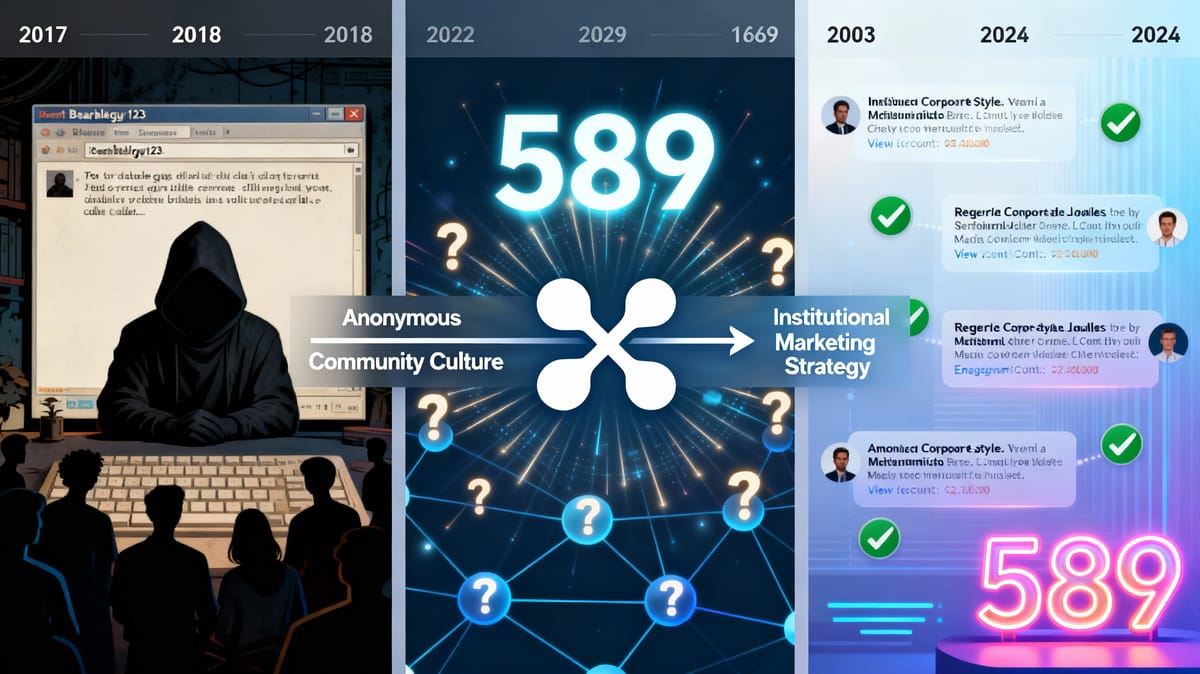
What started as cryptic posts from an anonymous bear has evolved into a billion-dollar engagement strategy. When Solana's official account posted "589" on December 8, 2024, generating over 3.1 million views, it marked a watershed moment: XRP's underground riddle culture had officially become mainstream institutional marketing.
589
— Solana (@solana) December 8, 2025
Time to flip the switch pic.twitter.com/OfZgGg226l
— Solana (@solana) December 9, 2025
The question is no longer whether major platforms will drop XRP hints—it's why this strategy works so effectively, and what it means for the future of crypto community engagement.
The Revolution's Origins: From r/Rippled to Corporate Marketing
The riddle revolution began modestly in 2017-2018 when Bearableguy123 (BG123) started posting cryptic images on Reddit's r/Rippled and Twitter. A cartoon bear wearing a crown, castles with symbolic flags, and mysterious numbers—especially "589"—became the foundation of what would become XRP's most distinctive cultural characteristic.
What made BG123's approach revolutionary wasn't the riddles themselves, but the community response they triggered. According to historical accounts, when BG123 posted images of children, Ripple announced a $29 million donation to DonorsChoose.org weeks later. When BG123 shared pictures of MoneyGram and Walmart, MoneyGram subsequently announced trials of Ripple's xRapid product.
These apparent "predictions" created a template: post cryptic content, embed recognizable symbols, let the community decode frantically, watch engagement explode. Whether BG123 was an insider, lucky guesser, or master of ambiguous timing didn't matter—the engagement mechanics proved devastatingly effective.
Fast forward to 2024, and that same template is being deployed by verified institutional accounts with market capitalizations in the billions.
Case Study: Solana's 589 Gambit
On December 8, 2024, Solana posted a single number: "589." No context. No explanation. Just three digits that XRP holders instantly recognized as their community's most iconic (and controversial) symbol.
The results were staggering. Within 24 hours, the post achieved:
- 3.1+ million views (Solana's highest engagement ever)
- 9,700+ likes
- 2,500+ replies
- Widespread coverage across crypto media
XRP validator Vet observed: "The post created Solana's most successful moment on X and demonstrated the strength of XRP's social reach." Crypto analyst John Squire added, "Crazy that the biggest post in Solana history is basically an XRP tribute."
Solana doubled down days later by tagging Ripple CTO David Schwartz with "Time to flip the switch," generating millions more views and keeping speculation alive about potential RLUSD integration or cross-chain collaboration.
The Revolutionary Shift: What BG123 did anonymously and mysteriously, Solana did openly and strategically—yet the community response remained remarkably similar.
Case Study: Gemini's Systematic Riddle Campaigns
Gemini exchange has transformed BG123's guerrilla tactics into systematic marketing campaigns, demonstrating how institutions can professionalize riddle culture while maintaining its engagement power.
eXploRing fast settlement makes every Payment feel limitLess
— Gemini (@Gemini) December 10, 2025
January 2024 Campaign
Gemini launched a coordinated series of cryptic posts:
- "Don't forget about XRP"
- "xcited about xrp"
- "xrriving shortly"
The campaign culminated in a formal riddle: "In the land of giants, I'm swift and small, when I run I don't stall. Across borders, I freely roam, in markets near and far from home. What am I?"
The XRP community immediately mobilized, flooding responses and generating massive organic reach. The riddle perfectly described XRP's technical characteristics—fast settlement, low costs, cross-border functionality—while maintaining plausible deniability about what Gemini would actually announce.
The payoff: Gemini announced XRP perpetual contracts and expanded trading options, validating community speculation while demonstrating ROI on the riddle campaign.
December 2024 Campaign
Gemini recently revived the strategy with "eXploRing fast settlement makes every Payment feel limitLess"—capitalizing X, R, P, and L. The timing aligned with Mastercard, Gemini, Ripple, and WebBank testing RLUSD settlement on XRPL for card payments, creating legitimate context for speculation.
The Revolutionary Pattern: Gemini has systematized what BG123 pioneered, creating predictable riddle-to-announcement cycles that train the community to engage while maintaining corporate credibility.
The Marketing Revolution: Why Institutions Adopted Riddle Culture
The transformation from anonymous hints to institutional strategy reveals several revolutionary insights about crypto marketing:
1. Community-Driven Virality Beats Paid Advertising
Traditional crypto marketing relies on paid promotions, influencer partnerships, and targeted advertising. Riddle marketing leverages existing community behavior to generate organic reach that money can't buy.
Solana's 589 post cost nothing beyond staff time to type three digits, yet achieved 3.1 million views—engagement that would cost hundreds of thousands in traditional advertising. The XRP community did the marketing work themselves through decoding, sharing, and amplifying.
2. Cross-Ecosystem Bridge Building
Riddles create conversation between competing blockchain communities. Speculation about RLUSD launching on Solana emerged immediately after the 589 post, forcing both communities to consider cross-chain possibilities.
The Revolutionary Insight: Riddles don't just engage existing communities—they create pathways for ecosystem expansion by making competitors curious about each other.
3. Regulatory-Safe Speculation
Here's where the revolution gets sophisticated: riddles allow institutions to generate buzz about potential developments without making concrete claims that could attract regulatory scrutiny.
When Gemini posts a riddle, they're not:
- Making price predictions (illegal market manipulation)
- Announcing unconfirmed partnerships (potential securities violations)
- Providing investment advice (requires licensing)
They're simply posting creative content that happens to reference XRP characteristics. The community interprets, speculates, and amplifies—but the institution maintains plausible deniability.
The Revolutionary Framework: Riddles are legally defensible hype generation.
4. Behavioral Data Collection
Every riddle campaign generates valuable data about community sentiment, interpretation patterns, and engagement triggers. Institutions learn:
- Which symbols resonate most strongly
- How quickly communities mobilize
- What speculation emerges organically
- Which narratives gain traction
This intelligence informs actual product development and marketing strategies.
The Psychology Revolution: Why XRP Holders Are Primed for Riddles
Understanding why riddle marketing works requires examining the psychological foundation BG123 built:
Pattern Recognition Addiction
Years of decoding BG123 riddles trained XRP holders to search for hidden meanings in ambiguous content. When institutions post anything remotely cryptic, this trained behavior activates automatically.
Research suggests this taps into fundamental human psychology: "Meme coins thrive on social proof, virality, and FOMO (fear of missing out)." Riddles add an additional layer—the intellectual satisfaction of "solving" puzzles combined with potential financial implications.
Community Identity Reinforcement
Responding to riddles reinforces XRP holder identity. When Solana posts 589, recognizing the reference signals membership in an exclusive cultural club. Explaining it to outsiders strengthens in-group bonds.
The Revolutionary Dynamic: Institutions aren't just marketing to XRP holders—they're activating a pre-existing identity framework.
Hope Maintenance During Uncertainty
XRP's journey has included regulatory battles, market volatility, and prolonged periods below previous highs. Riddles provide hope during uncertainty—the suggestion that insiders know positive developments are coming.
Some observers note this can be exploitative: "Solana trolled the XRP army with recent 589 X post." The line between engagement and manipulation becomes blurry when institutions leverage community psychology for visibility.
The Dark Side: When Revolution Becomes Exploitation
The transformation from anonymous hints to institutional marketing isn't purely positive. Several concerning dynamics have emerged:
Perpetuating Unrealistic Expectations
The number 589, while culturally significant, represents a price target many analysts dismiss as fantasy. When major platforms reference it—even ironically—they risk encouraging unrealistic expectations among less sophisticated investors.
The Problem: BG123's original riddles carried implicit risk (anonymous source, speculative interpretation). Institutional riddles carry implicit authority (verified platforms, professional marketing teams) while maintaining the same speculative ambiguity.
Information Asymmetry
Institutions know whether their riddles reference real developments or simply generate engagement. Community members invest time, emotional energy, and sometimes capital based on interpretations that may be completely wrong.
When Gemini posted riddles in January 2024, they knew exactly what announcements would follow. The community speculated blindly—some correctly, others wildly wrong. This asymmetry favors institutions while potentially misleading participants.
Engagement Farming vs. Substance
Some analysis suggests Solana's 589 post was pure engagement farming with no substantive meaning. If true, this represents institutions exploiting community psychology for visibility without providing value.
The Revolutionary Question: Has riddle culture evolved from community-driven speculation into institutional manipulation?
Recent Market Context: Revolution During Volatility
The riddle revolution's latest phase coincides with significant XRP market dynamics. As of December 10, 2024, XRP trades around $2.04-$2.37, having experienced a 30% pullback from December highs near $2.90.
Institutional riddles emerged during this volatility alongside legitimate developments:
- XRP spot ETFs surpassed $1 billion in cumulative inflows faster than most crypto funds
- Mastercard, Gemini, Ripple and WebBank tested RLUSD settlement on XRPL for card payments
- Speculation increased about RLUSD expansion across multiple blockchains
- Ripple CTO David Schwartz addressed XRP's undervaluation despite 40+ billion XRP in escrow
The Revolutionary Timing: Institutions deploy riddles during both positive developments (amplifying good news) and market uncertainty (maintaining hope), making them all-weather marketing tools.
Beyond XRP: The Broader Revolutionary Impact
While riddle marketing emerged from XRP culture, its institutional adoption suggests broader implications for crypto marketing:
Other Communities Take Notice
The success of riddle campaigns targeting XRP holders hasn't escaped notice from other cryptocurrency communities. Expect similar strategies targeting:
- Bitcoin maximalists with cryptic references to Satoshi
- Ethereum communities with EIP-related mysteries
- Solana ecosystem participants with validator hints
The Revolutionary Spread: What began as XRP-specific culture could become industry-standard practice.
Traditional Marketing Evolution
Crypto's riddle revolution may influence marketing beyond blockchain. The formula—create mystery, leverage existing community behavior, maintain plausible deniability—applies to any industry with engaged online communities.
Regulatory Response Pending
As riddle marketing becomes more prevalent and sophisticated, regulators may develop frameworks addressing it. Questions arise:
- When does cryptic marketing become market manipulation?
- Do institutions have disclosure obligations about riddle intentions?
- Should there be consequences for riddles that mislead communities?
The Revolutionary Uncertainty: The rules governing this new marketing paradigm haven't been written yet.
The Original Riddler's Validation
Perhaps the ultimate revolutionary moment came when institutions validated what BG123 pioneered. The anonymous account that disappeared around 2019 created something valuable enough that billion-dollar platforms now replicate the formula.
Whether BG123 was:
- A Ripple insider dropping genuine hints
- A lucky guesser with good timing
- A community member creating engagement for fun
- David Schwartz himself (as some speculated)
...doesn't matter anymore. The method proved sustainable, scalable, and institutionally adoptable.
The Revolutionary Legacy: Anonymous community creativity became corporate strategy.
What This Revolution Means for XRP's Future
The institutionalization of riddle culture creates both opportunities and risks for XRP:
Opportunities
Sustained Visibility: When major platforms reference XRP, it maintains mindshare even during quiet development periods. Solana's 589 post put XRP in front of millions who might never otherwise encounter it.
Cross-Chain Legitimacy: Institutional riddles suggesting potential collaborations (RLUSD on Solana, Gemini partnerships) create narrative space for actual integrations to develop.
Community Cohesion: Shared riddle decoding experiences strengthen community bonds and maintain engagement during market downturns.
Risks
Disappointment Cycles: When riddles hint at developments that don't materialize, community morale suffers. Repeated cycles could erode trust.
Regulatory Scrutiny: If riddle marketing becomes associated with price manipulation or investor harm, it could attract unwanted regulatory attention to XRP.
Diluted Meaning: As more institutions deploy riddles, their special significance diminishes. What felt like insider hints becomes obvious marketing, reducing effectiveness.
Key Takeaways: Understanding the Revolution
The transformation of XRP's riddle culture from anonymous BG123 posts to institutional marketing strategy represents a unique case study in crypto community dynamics:
- Community behavior can become institutional strategy. What starts as grassroots culture may be professionalized and scaled by corporations.
- Engagement metrics override authenticity. Whether riddles contain genuine information matters less than the engagement they generate.
- Regulatory gray areas enable innovation. Riddles exist in legal space that traditional marketing can't access, creating competitive advantages.
- Psychology beats technology in marketing. The most sophisticated blockchain features matter less than cryptic posts that tap into community identity and hope.
- Institutional adoption validates community culture. When Solana references 589, it acknowledges XRP's cultural power, even if ironically.
However, investors must separate riddle entertainment from investment analysis. While Gemini's cryptic posts and Solana's 589 reference generate excitement, sound investment decisions require evaluating:
- XRP ETF inflow data ($1B+ cumulative)
- Real institutional testing (Mastercard/Ripple RLUSD trials)
- Regulatory developments (improved U.S. clarity)
- Technical adoption metrics (XRPL transaction volumes, developer activity)
- Fundamental value propositions (settlement speed, transaction costs, network effects)
The riddle revolution proves XRP's community possesses unique cultural assets that institutions value. Whether this translates to sustainable price appreciation depends on factors far beyond clever marketing—but the attention certainly doesn't hurt.
The Revolutionary Question Remains
Have anonymous hints become institutional marketing? Absolutely. The evidence is overwhelming—from Solana's record-breaking 589 post to Gemini's systematic riddle campaigns.
The deeper question is whether this evolution strengthens or undermines the original community culture. Does institutional adoption validate XRP's unique characteristics, or does it exploit community psychology for corporate gain?
Perhaps both are true. The riddle revolution has entered a new phase where the boundaries between community culture, marketing strategy, and potential manipulation blur together. Understanding these dynamics helps participants navigate the space more intelligently—whether they're decoding the next cryptic hint or building portfolios based on fundamental analysis.
What began with an anonymous bear posting cryptic images has become a mainstream crypto marketing phenomenon. The revolution is complete. The question now is what comes next.
DISCLAIMER: This newsletter is for informational purposes only and does not constitute investment advice, advertising, or a recommendation to buy, sell, or hold any securities. This content is not sponsored by or affiliated with any of the mentioned entities. Investments in cryptocurrencies or other financial assets carry significant risks, including the potential for total loss, extreme volatility, and regulatory uncertainty. Past performance is not indicative of future results. Always consult a qualified financial professional and conduct thorough research before making any investment decisions.
Sources
- Coinpaper: Solana 589 Post - Solana's viral XRP reference
- The Crypto Basic: Solana's Official 589 Share - Community reaction analysis
- U.Today: Gemini Cryptic XRP Hint - Recent Gemini riddle
- U.Today: Solana XRP Teaser - CTO mention
- MoneyCheck: Ripple CTO Claims - Schwartz on undervaluation
- Crypto.ro: Solana Trolled XRP - Alternative interpretation
- AInvest: Strategic Analysis - Marketing strategy breakdown
- Crypto Economy: MoonPay 589 - Additional institutional hints
- The Crypto Basic: Gemini January Riddle - Historical riddle campaign
- Bitcoinist: Gemini Major XRP News - Previous hint analysis
- CoinEdition: Gemini Speculation - Community response
- CryptoNews: Gemini Riddle Series - Riddle interpretation
- CryptoPotato: Gemini Good News - Product announcements
- Medium: Bearableguy123 History - Original riddle phenomenon
- XRP Community Blog - BG123 predictions
- Steemit: BG123 Insider Theory - Community analysis
- Steemit: How Legit Is BG123 - Skeptical perspective
- Blockchain Reporter: Schwartz Tweet - CTO cryptic messages
- Kraken: XRP Price - Current market data
- Finance Magnates: XRP Down Today - Recent price analysis