Wall Street Goes On-Chain: The SEC Just Approved Tokenized Stock Trading on Nasdaq
The SEC approved Nasdaq's tokenized securities rule today. Stocks from the Russell 1000 and S&P 500 ETFs can now trade in blockchain form alongside traditional shares — no new regulations needed. Here's what changed and why it matters for crypto.

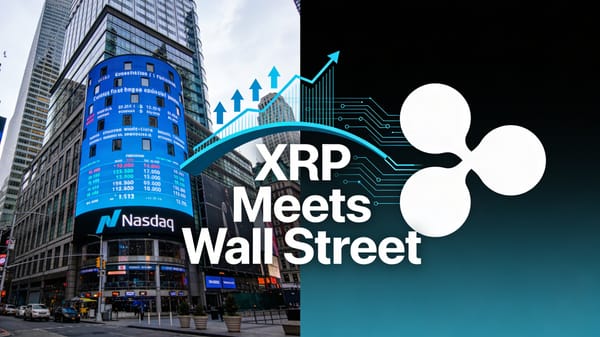
The U.S. Securities and Exchange Commission approved a landmark Nasdaq rule change today, March 18, 2026, allowing eligible securities to be traded in tokenized form on the exchange — a move that signals the most direct convergence of regulated capital markets and blockchain infrastructure in U.S. history.
What Was Actually Approved
The approval allows eligible securities, including stocks from the Russell 1000 and ETFs tracking major indices such as the S&P 500, to be represented and traded as tokenized assets on Nasdaq.
This isn't a crypto product. It's the same stock you already own — just settled differently.
According to Nasdaq's own Q&A on the proposal, a security may be traded on Nasdaq in either traditional form — a digital representation of ownership and rights without utilizing distributed ledger technology — or tokenized form, which uses distributed ledger or blockchain technology. Upon entry of the order, a participant can select to clear and settle in regular or tokenized form, and the exchange communicates that instruction to the DTC.
Under the framework, tokenized securities must remain fully fungible with their traditional counterparts, sharing the same ticker, CUSIP, and shareholder rights. Investors in tokenized shares will retain standard protections, including voting rights, dividend access, and claims on residual assets, ensuring consistency with existing securities laws.
The mechanics flow through the Depository Trust Company. As Greenberg Traurig's analysis of the rule filing notes, Nasdaq anticipates that DTC would mint and deliver tokenized assets to participants' digital wallets; tokenized trades would settle on a T+1 basis, consistent with current standards; and market data feeds and fee schedules would treat tokenized and traditional shares identically.
Critically, no new regulatory framework was required. Katten Muchin Rosenman's review of the rule found that Nasdaq's proposal operates within the existing framework of U.S. securities laws, including the Securities Exchange Act, SEC Regulation National Market System, and a complex web of rules governing broker-dealers, clearing agencies, and transfer agents — applying existing rules to blockchain-based settlement rather than asking regulators to create new exemptions or adopt novel rules.
Why This Moment Is Different
This isn't the first time someone has floated the idea of putting stocks on a blockchain. What makes today's approval distinct is what's happening around it.
As Nasdaq's own analysis of tokenization's 2026 trajectory notes, major financial institutions such as BlackRock, Franklin Templeton, and JPMorgan have already launched tokenized funds. These, alongside a likely surge in stablecoin usage, could be the tipping point. Standard Chartered CEO Bill Winters told a conference in late 2025 that we'll eventually see the majority of transactions settled on the blockchain.
The numbers back that up. According to CryptoSlate's December 2025 deep-dive on the shift, tokenized U.S. Treasury products grew from under $2 billion in mid-2024 to nearly $10 billion by late 2025 across multiple issuers — with the plumbing connecting Wall Street custody to Ethereum rails now in production, not proof-of-concept.
BlackRock's USD Institutional Digital Liquidity Fund (BUIDL) on Ethereum crossed multi-billion AUM during 2025. J.P. Morgan's Onyx platform moved out of pilot phase into live production with large buy-side firms, enabling tokenized money market fund shares and other assets to be pledged and released intra-day with programmable conditions.
The New York Stock Exchange followed in early 2026 by announcing plans to build its own 24/7 tokenized securities trading platform, aiming to offer a new venue for continuous trading of tokenized U.S. equities and ETFs powered by stablecoin-based funding.
The SEC's approval of Nasdaq's rule doesn't exist in a vacuum — it's a capstone on a multi-year institutional migration toward blockchain infrastructure.
The Regulatory Context
One of the more significant aspects of today's approval is how regulators framed it. Both the SEC and Nasdaq argued that tokenization requires no special carve-outs — it's simply a different settlement rail for the same regulated asset.
As the Federal Register filing makes clear, Commissioner Peirce stated that "tokenized securities are still securities" and "market participants must consider — and adhere to — the federal securities laws when transacting in these instruments."
CoinDesk's January 2026 coverage of the SEC's guidance reported that the SEC drew a sharp line between issuer-sponsored tokenized securities, which can represent true equity ownership, and third-party products that typically provide only synthetic exposure or custodial entitlements — signaling intent to curb the spread of synthetic equity products to retail investors while steering compliant tokenization toward issuer-approved, fully regulated structures.
That distinction matters. Products that dress up as tokenized stocks without proper regulatory standing are increasingly in the crosshairs. The structure Nasdaq just received approval for represents exactly the direction regulators want the market to move.
This effort seems likely to garner serious attention in light of the Trump administration's and SEC Chairman Paul Atkins' emphasis on strengthening American leadership in digital financial technology and making America the "crypto capital of the world."
What This Means for the Broader Crypto Market
For the digital asset ecosystem, today's approval reinforces a structural reality that's been building for two years: the convergence of TradFi and crypto isn't coming — it's already here, and the regulatory apparatus is now validating it.
INX's comprehensive 2025 RWA market overview found that 2025 marked the first year where major traditional financial institutions like BlackRock, Franklin Templeton, and Nasdaq went beyond pilots and into production-level tokenization. With over $33 billion in tokenized assets and new regulations paving the way for compliant issuance, the RWA market has officially moved from experimentation to mainstream finance.
Blockchain infrastructure that was previously the domain of crypto-native protocols is now being embedded directly into the world's most liquid equity markets. As Propeller Industries' analysis put it, this isn't crypto companies trying to look legitimate by partnering with banks: it's banks recognizing that blockchain infrastructure solves real problems they've been wrestling with for decades.
For crypto market participants, the implications run deeper than equities. Robinhood introduced tokenized stocks for European customers, highlighting the ability to buy tokenized shares in private companies that would otherwise be out of reach for many retail investors. Coinbase launched tokenized stocks for U.S. investors at the end of 2025.
As regulated tokenization expands into equities, it validates the infrastructure — blockchains, smart contracts, digital wallets, stablecoins — that underpins the broader crypto ecosystem. More institutional capital flowing through these rails raises the maturity and credibility of the infrastructure overall.
It's worth noting what hasn't been confirmed: there are no official announcements yet regarding 24/7 trading enabled by today's approval, specific DeFi integrations, or pricing advantages over traditional settlement. Those conversations are active in industry circles, but they remain speculative until formally proposed and approved.
What Comes Next
Greenberg Traurig advises that broker-dealers and market makers should assess system readiness for tokenization flags and DTC integration and consider procedural changes that may be needed to participate in ETPs as tokenized shares of these products grow in popularity.
On timeline, Katten's analysis notes that the first token-settled trades are potentially set to occur by the end of the third quarter of 2026.
The larger picture: Wall Street spent a decade treating blockchain as a curiosity. What's happening now is different in kind, not just degree. The SEC's approval today puts the regulatory stamp on a trajectory that BlackRock, JPMorgan, Franklin Templeton, and now Nasdaq's own exchange have been building toward — a capital markets infrastructure where blockchain settlement isn't an alternative, but an option sitting right next to the traditional one, on the same order book.
DISCLAIMER: This newsletter is for informational purposes only and does not constitute investment advice, advertising, or a recommendation to buy, sell, or hold any securities. This content is not sponsored by or affiliated with any of the mentioned entities. Investments in cryptocurrencies or other financial assets carry significant risks, including the potential for total loss, extreme volatility, and regulatory uncertainty. Past performance is not indicative of future results. Always consult a qualified financial professional and conduct thorough research before making any investment decisions.
Sources
| # | Source | Publication |
|---|---|---|
| 1 | SEC Order Approving Nasdaq Rule Change — SR-NASDAQ-2025-072 | U.S. Securities and Exchange Commission |
| 2 | SEC Approves Tokenized Securities to Trade Alongside Traditional Stocks | Crypto Briefing, March 18, 2026 |
| 3 | Q&A: Nasdaq's New Proposal for Tokenized Securities | Nasdaq Newsroom |
| 4 | Nasdaq Proposes Rule Changes to Enable Trading of Tokenized Securities | Greenberg Traurig LLP |
| 5 | Evaluating Nasdaq Tokenization Rule's Potential Impact | Katten Muchin Rosenman LLP |
| 6 | SEC Clarifies Rules for Tokenized Stocks | CoinDesk, January 29, 2026 |
| 7 | 4 Industries Real-World Asset Tokenization Could Transform in 2026 | Nasdaq / The Motley Fool |
| 8 | Tokenized U.S. Treasuries Hit $9B — The Shift That Changes DeFi's Foundation | CryptoSlate, December 2025 |
| 9 | Real-World Asset Tokenization: The $10 Trillion Bridge Between TradFi and DeFi | Propeller Industries |
| 10 | Federal Register — Nasdaq Tokenized Securities Rule Filing | Federal Register, January 30, 2026 |
| 11 | Real-World Asset Tokenization Market Recap 2025 | InvesTax |