US Treasury Recognizes Singapore's Crypto Leadership at Historic APEC Meeting
US Treasury Secretary recognizes Singapore's digital asset framework at APEC 2025, signaling new era of international crypto cooperation. The meeting highlights converging stablecoin regulations that could reshape global finance and reinforce dollar dominance.
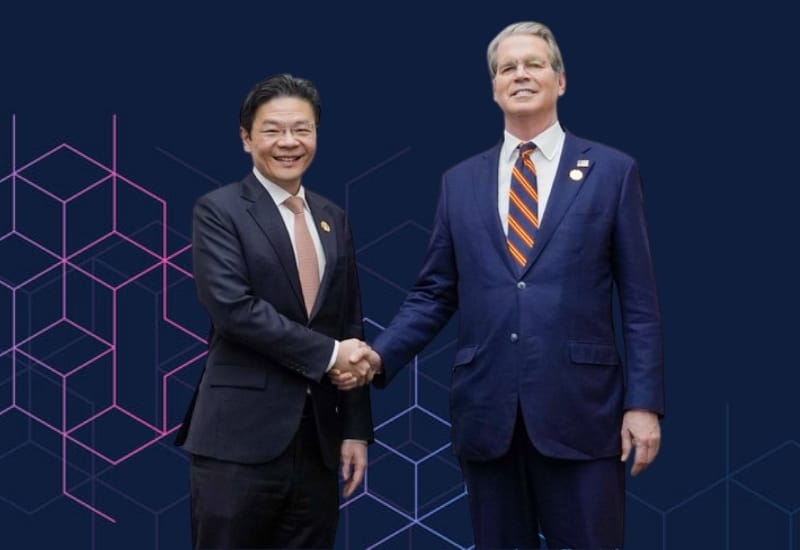
At the Asia-Pacific Economic Cooperation (APEC) summit in Gyeongju, South Korea, US Treasury Secretary Scott Bessent held a pivotal meeting with Singapore Prime Minister Lawrence Wong that may signal a new era of international cooperation on digital asset regulation. The official readout from the US Department of Treasury confirmed that Secretary Bessent "recognized Singapore's efforts in increasing adoption and use of digital assets and U.S. dollar stablecoins," marking a rare public endorsement of a foreign nation's cryptocurrency framework by American financial leadership.
This acknowledgment comes at a critical moment when stablecoin markets have surged to over $250 billion in total value, with projections suggesting the market could reach $2 trillion by 2028. The meeting represents more than diplomatic courtesy—it signals the US government's strategic recognition that international cooperation on stablecoin adoption may be essential for maintaining dollar dominance in an increasingly digital global economy.
JUST IN: 🇺🇸🇸🇬 U.S. Treasury Secretary Scott Bessent said he and Singapore’s Prime Minister Lawrence Wong discussed “increasing adoption and use of digital assets and U.S. dollar stablecoins.” pic.twitter.com/UEsnxZCyro
— Whale Insider (@WhaleInsider) October 31, 2025
Singapore's Model: Why the US Is Paying Attention
Singapore has emerged as one of the world's most sophisticated regulatory environments for digital assets. The Monetary Authority of Singapore (MAS) has implemented a comprehensive framework that balances innovation with consumer protection, a model that contrasts sharply with the regulatory uncertainty that plagued the US crypto industry until recently.
The city-state's stablecoin regulatory framework, finalized in August 2023, applies to single-currency stablecoins pegged to the Singapore Dollar or any G10 currency issued within Singapore. Key requirements include 100% reserve backing in high-quality liquid assets, monthly disclosure obligations, and strict capital requirements—provisions remarkably similar to those outlined in the US GENIUS Act passed in July 2025.
Singapore's framework mandates that stablecoin issuers maintain reserves equal to 100% of coins in circulation, hold capital buffers, provide clear redemption rights, and submit to regular audits. Only stablecoins meeting these stringent requirements can be labeled "MAS-regulated stablecoins," creating a quality tier that protects consumers while encouraging compliant innovation.
As of June 2025, Singapore further tightened its regulatory oversight by requiring all Singapore-based crypto firms offering services overseas to obtain licensing under the Financial Services and Markets Act, effectively closing regulatory arbitrage loopholes that allowed firms to register in Singapore while operating elsewhere with minimal oversight.
The Convergence of US and Singapore Frameworks
The timing of Bessent's recognition is significant because it follows the July 2025 passage of the Guiding and Establishing National Innovation for U.S. Stablecoins (GENIUS) Act, America's first comprehensive federal stablecoin legislation. Both frameworks share fundamental principles: mandatory reserve backing, transparent disclosure requirements, and strict compliance standards designed to ensure stablecoins maintain their peg while protecting consumers.
Treasury Secretary Bessent has articulated the Trump administration's vision that "stablecoins represent a revolution in digital finance" and that "the dollar now has an internet-native payment rail that is fast, frictionless, and free of middlemen." This perspective aligns closely with Singapore's approach of viewing regulated stablecoins as infrastructure for modern finance rather than speculative instruments.
The convergence extends beyond regulatory philosophy to practical implementation. Both jurisdictions recognize that stablecoins, when properly regulated, can serve as strategic tools for currency dominance. With over 90% of fiat-backed stablecoins pegged to the US dollar, and with issuers like Tether and Circle holding approximately $180 billion in US Treasuries, stablecoins have become an unexpected pillar supporting American monetary policy.
Implications for the Global Crypto Ecosystem
This US-Singapore alignment signals broader implications for the cryptocurrency industry. According to TRM Labs' 2025 Crypto Adoption Report, stablecoins now account for 30% of all crypto transaction volume, with annual volumes reaching over $4 trillion in 2025—an 83% increase from 2024. The maturation of regulatory frameworks in both jurisdictions provides legitimacy that institutional investors have long demanded.
JPMorgan analysts project that stablecoin adoption could drive trillions of dollars in inflows, reinforcing rather than undermining dollar dominance. This view aligns with Secretary Bessent's statement that stablecoins will "buttress the dollar's status as the global reserve currency" and "lead to a surge in demand for US Treasuries."
The meeting's broader context matters. Global retail-led crypto adoption accelerated by 125% between January-September 2024 and the same period in 2025, with individuals increasingly using digital assets for practical use cases like payments, remittances, and value preservation in volatile economic conditions. This growth has occurred despite—or perhaps because of—increased regulatory clarity.
The Geopolitical Chess Game
The US-Singapore alignment on stablecoins occurs within a complex geopolitical landscape. The European Union has taken a different approach through its Markets in Crypto-Assets (MiCA) regulation, which some analysts view as deliberately creating barriers to US dollar-denominated stablecoins to protect European monetary sovereignty. Meanwhile, Hong Kong passed its Stablecoin Ordinance in May 2025, joining Singapore as an Asian regulatory leader.
European Central Bank President Christine Lagarde has emphasized concerns about US dollar-denominated stablecoins threatening European monetary policy and autonomy, pushing instead for the development of a digital euro. This divergence highlights how stablecoin regulation has become a strategic tool in monetary policy competition.
The recognition of Singapore's framework by US Treasury leadership suggests a deliberate strategy to build a coalition of aligned jurisdictions that support dollar-denominated stablecoins under similar regulatory standards. This approach could create regulatory magnetism where other nations adopt compatible frameworks to participate in the growing stablecoin economy.
Impact on Institutional Adoption
Clear regulatory frameworks in major financial centers like the US and Singapore remove a significant barrier to institutional adoption. McKinsey analysis indicates that stablecoin transaction volumes could surpass legacy payment systems within a decade if current growth rates continue, driven by the ability to operate continuously, satisfy demand for instant settlement, and offer improved operational controls.
Major financial institutions are responding. Standard Chartered Bank announced partnerships to launch a Hong Kong dollar-pegged stablecoin, while several US banks are exploring jointly issuing stablecoins. PayPal, Bank of America, and Stripe have either launched stablecoins or indicated intentions to enter the market.
The convergence of US approval and Singapore's proven framework provides a template that reduces compliance complexity for institutions operating across jurisdictions. This regulatory harmonization—even if imperfect—accelerates the integration of stablecoins into mainstream finance.
Looking Forward: A New Architecture for Global Finance
The Bessent-Wong meeting at APEC 2025 represents more than a bilateral acknowledgment—it signals the emergence of a new architecture for global digital finance. As Citi analysts project, the stablecoin market could reach $1.9 trillion by 2030 in base case scenarios, with bull case projections as high as $4 trillion.
This growth will occur within increasingly coordinated regulatory frameworks. The Financial Stability Board has called on G20 nations to complete full adoption of global crypto regulatory frameworks by year-end 2025, with stablecoins topping the agenda. The US-Singapore alignment provides a model for how major financial centers can support innovation while maintaining monetary policy control.
For the broader cryptocurrency ecosystem, this regulatory maturation represents both opportunity and constraint. The era of regulatory arbitrage and minimal oversight is ending, replaced by frameworks that demand compliance but offer legitimacy. Projects that can navigate these requirements gain access to institutional capital and mainstream adoption; those that cannot will find themselves increasingly marginalized.
The message from Gyeongju is clear: stablecoins have graduated from crypto curiosity to strategic financial infrastructure. The question is no longer whether governments will regulate digital assets, but how—and whether those frameworks will support or constrain the transformative potential of blockchain technology. The US-Singapore model suggests a path forward that balances innovation with stability, a pragmatic approach that may define digital finance for the next decade.
DISCLAIMER: This newsletter is for informational purposes only and does not constitute investment advice, advertising, or a recommendation to buy, sell, or hold any securities. This content is not sponsored by or affiliated with any of the mentioned entities. Investments in cryptocurrencies or other financial assets carry significant risks, including the potential for total loss, extreme volatility, and regulatory uncertainty. Past performance is not indicative of future results. Always consult a qualified financial professional and conduct thorough research before making any investment decisions.
Sources
- US Department of Treasury - Readout from Secretary Bessent's Meeting with Singapore Prime Minister
- US Department of Treasury - Statement on GENIUS Act Enactment
- US Department of Treasury - Secretary Bessent Remarks on Digital Assets
- Monetary Authority of Singapore - Stablecoin Regulatory Framework
- TRM Labs - 2025 Crypto Adoption and Stablecoin Usage Report
- McKinsey - Stablecoins: Payments Infrastructure for Modern Finance
- World Economic Forum - How the GENIUS Act Works
- World Economic Forum - Stablecoin Surge Analysis
- East Asia Forum - Can Stablecoins Extend US Dollar Dominance?
- CryptoSlate - Treasury Secretary on Stablecoin Demand for Government Debt
- Bloomberg - Stablecoin Adoption and Dollar Buying
- Global Legal Insights - Singapore Blockchain & Cryptocurrency Laws 2026
- Atlantic Council - Central Bank Digital Currencies vs Stablecoins
- European Central Bank - From Hype to Hazard: What Stablecoins Mean for Europe
- Visual Capitalist - Stablecoin Market Size Forecast into 2030
- Crypto.com - Regulatory Shifts in Crypto 2025
- CCN - Who is Scott Bessent? Former Hedge Fund Manager Now Leading US Treasury
- Ledger Insights - Singapore Firms Targeting Offshore Crypto Clients Must Get Licensed
- Bitget Academy - Singapore Crypto Rules 2025: What to Know
- FinTech Law Blog - Singapore Stablecoin Regulatory Framework