"The Bitcoin Cycle Is Dead," Says Cathie Wood—And Wall Street Agrees
ARK's Cathie Wood declares Bitcoin's 4-year cycle dead as institutional capital reshapes crypto's boom-bust pattern—what this means for mainstream finance adoption.

,ARK Invest CEO Cathie Wood has declared that Bitcoin's historic four-year cycle is ending, arguing that institutional adoption is fundamentally reshaping the cryptocurrency's market behavior. In an interview with Fox Business this week, Wood stated that the predictable boom-and-bust pattern tied to Bitcoin's halving events is being disrupted by unprecedented institutional capital flows.
JUST IN: Ark Invest’s Cathie Wood says #Bitcoin’s 4-year cycle is going to be disrupted, and we may have seen the lows already 🚀 pic.twitter.com/9xBnb7H2kJ
— Bitcoin Magazine (@BitcoinMagazine) December 9, 2025
Wood noted that Bitcoin's volatility has declined significantly, with crashes becoming less severe than the 75-90% drops seen in earlier years. "The volatility's going down," she explained, adding that institutional investors entering the asset class will prevent extreme declines. Wood suggested the market may have already seen its recent low just weeks ago.
The Traditional Four-Year Pattern
Bitcoin's four-year cycle has historically followed halving events, which reduce mining rewards by 50% approximately every four years. The most recent halving occurred on April 20, 2024, cutting the mining reward to 3.125 BTC, historically triggering supply squeezes and significant price rallies.
Previous halvings demonstrated clear patterns. The 2012 halving saw Bitcoin surge from under $10 to roughly $1,100; the 2016 halving fueled a climb from $400 to nearly $20,000; and the 2020 halving propelled the asset from $8,500 to around $69,000. Typically, these rallies were followed by dramatic corrections of 70-90% over multi-year periods, creating crypto winters that cleared out retail investors and reset market conditions.
What's Changed: Institutional Adoption
Wood's thesis centers on how spot Bitcoin ETFs and institutional capital have altered market dynamics. US spot Bitcoin ETFs approved in January 2024 have accumulated more than $100 billion by October 2025. Major asset managers like BlackRock have launched products that provide traditional investors with regulated access to Bitcoin.
More than 70 publicly listed companies now hold Bitcoin on their balance sheets, led by Strategy (formerly MicroStrategy) with 660,624 BTC worth approximately $62 billion. This corporate accumulation represents a new demand source that didn't exist during previous cycles. Companies like Tesla, Block, and numerous others have added Bitcoin to their treasuries, signaling confidence in its long-term value proposition.
Wood argued that Bitcoin now trades more like a risk-on asset, moving in line with equities and real estate rather than acting as a hedge. She noted that gold has assumed the traditional risk-off role, with investors using it to protect against geopolitical shocks. This behavioral shift marks a fundamental change in how institutional traders approach Bitcoin allocation within diversified portfolios.
Industry Consensus Building
Wood isn't alone in this assessment. Standard Chartered analyst Geoffrey Kendrick released a report stating that "With the advent of ETF buying, we think the BTC halving cycle is no longer a relevant price driver." The British multinational bank halved its 2025 Bitcoin price target from $200,000 to $100,000, acknowledging the market's structural transformation.
CryptoQuant founder Ki Young Ju wrote "The cycle is dead," while Bitwise CIO Matt Hougan and VanEck's Matthew Sigel have echoed similar sentiments about institutional inflows erasing traditional patterns. Even former Binance CEO Changpeng Zhao stated at the Bitcoin MENA conference in December that the Bitcoin halving cycle "seems to have ended."
According to Kendrick's analysis, three major episodes of combined ETF and corporate buying—around 250,000 BTC, 450,000 BTC, and another 250,000 BTC in rolling quarterly flows—lined up with major price surges through March 2024, early 2025, and July 2025. However, these inflows have recently declined to approximately 50,000 BTC per quarter, contributing to recent price weakness and demonstrating the market's sensitivity to institutional capital flows.
New Market Characteristics
The evolving cycle exhibits several distinct features. Volatility measured by 90-day realized volatility has fallen below 40 percent—a 50 percent decline from 2021 levels. Bitcoin's correction from its all-time high has been notably shallower than historical precedents, supporting the thesis that the market has fundamentally matured.
Bitcoin broke its previous all-time high of $69,000 even before the April 2024 halving, reaching around $73,000 in March 2024—a first in Bitcoin's history. This pre-halving rally marked a departure from the traditional pattern where new highs occurred months after the event, suggesting that market participants were already pricing in institutional demand rather than supply-side dynamics.
Some analysts reference the Bitcoin Power Law model, which views price growth as part of a long-term trajectory influenced by time rather than strict four-year windows. Sentora executive Patrick Heusser noted that halvings still matter, but only as interruptions within a broader trend, pointing out that "Daily supply reduced by only 450 BTC," which is marginal compared to Bitcoin's trillions in market value and the billions flowing through institutional channels.
Implications for Investors
Wood's revised forecast reflects both optimism and caution. ARK Invest lowered its 2030 Bitcoin price target from $1.5 million to $1.2 million in November 2025, citing stablecoins increasingly taking over functions originally attributed to Bitcoin. The firm's base-case scenario projects prices between $700,000 and $750,000, with a bear-case ranging from $300,000 to $500,000.
Standard Chartered's Kendrick projects Bitcoin will reach $150,000 in 2026, $225,000 in 2027, $300,000 in 2028, $400,000 in 2029, and $500,000 by 2030. Despite the adjustment, Kendrick explicitly rejected old halving-cycle models, stating "This time really is different" and asserting that "crypto winters are a thing of the past."
Analysts suggest that future corrections may be shallower—potentially 30-50% rather than 70-90%—while rallies could unfold over extended periods. This means investment strategies built around precise halving timing may no longer provide the same predictive accuracy, requiring traders and portfolio managers to adapt their approaches to the new institutional-driven market structure.
Current Market Conditions
Bitcoin is currently trading around $87,000, down from its October 2025 all-time high near $126,000. The cryptocurrency has tested support at $90,000 multiple times in recent weeks, with market observers noting a lack of immediate catalysts for significant upward movement.
U.S. Spot Bitcoin ETFs recorded $223.5 million in net inflows on December 10, according to Farside Investors, though inflows remain below the peaks seen earlier in 2024. The market now depends heavily on ETF demand, as corporate treasury buying from companies like Strategy has slowed significantly after aggressive accumulation throughout 2024.
The Federal Reserve's monetary policy remains a critical factor. Recent rate decisions and forward guidance about 2025's policy trajectory will likely influence risk assets including Bitcoin more than halving-related supply dynamics. The correlation between Bitcoin and traditional equity markets has strengthened, making macroeconomic conditions increasingly relevant to crypto price action.
Long-Term Structural Change
Wood maintains that institutional involvement represents a permanent structural shift rather than a temporary phenomenon. The market now shows deeper liquidity and milder retracements, with sustained accumulation patterns replacing retail-driven volatility.
However, challenges remain. Kendrick's analysis suggests that future price appreciation will depend almost entirely on ETF-buying activity, as the corporate treasury acquisition channel has essentially dried up. This creates a more fragile foundation than the dual support system that existed during 2024's rally, concentrating risk around a single demand source.
Broader economic forces now dictate Bitcoin's movement more than internal crypto market mechanics. Macro analyst Lyn Alden said Bitcoin's current market lacks the euphoria needed for a major collapse, with expectations that Bitcoin will reclaim $100,000 by 2026, though the path will be uneven.
What This Means for the Crypto Space: The Path to Mainstream
The death of Bitcoin's four-year cycle signals something far more significant than a change in price patterns—it represents cryptocurrency's evolution from a speculative fringe asset to a legitimate component of global financial infrastructure. This transformation has profound implications for the entire digital asset ecosystem and its integration into mainstream finance.
Institutional Infrastructure Building
By August 2025, institutions—including pension funds, sovereign wealth funds (SWFs), and corporate treasuries—had allocated over $58 billion in assets under management (AUM) across these ETFs, with BlackRock, Fidelity, and Ark Invest leading the charge. This isn't merely capital allocation; it's infrastructure building.
Banks and custodians, including JPMorgan, Citi, HSBC, State Street, and UBS, are launching initiatives on various fronts, such as custody, tokenised deposits, and settlement platforms, which could power global finance on blockchain infrastructure. These institutions aren't experimenting—they're building the rails for digital asset integration into core financial services.
Regulatory Clarity Accelerating Adoption
The acceleration of institutional adoption in 2024–2025 has been a game-changer. Regulatory developments, particularly in the U.S., have created a framework that legitimizes Bitcoin as an investable asset. The SEC's approval process has evolved dramatically, transforming what was once a regulatory minefield into a clearer pathway for financial products.
President Trump's January 23, 2025, executive order mandated a comprehensive federal crypto framework within 180 days, while also rescinding Staff Accounting Bulletin 121 (SAB 121)—the rule that previously forced banks to hold customer crypto assets on their balance sheets. This regulatory shift removes a massive barrier that prevented traditional banks from entering the crypto custody business.
The Supply-Demand Mathematics
The numbers tell a compelling story about mainstream adoption. A modest 2% to 3% crypto allocation across these pools generates US$3 trillion to US$4 trillion in potential institutional cryptocurrency demand. Bitcoin's total market value today is approximately $2.2 trillion, meaning institutional allocation at even conservative levels could fundamentally reshape the asset's price dynamics.
Over the next six years, miners will produce roughly 700,000 new Bitcoin. At current prices, that's US$77 billion in new supply. Meanwhile, institutional cryptocurrency demand could reach US$3 trillion in the same period. The supply-demand imbalance is 40-to-one. This mathematics explains why analysts view the current cycle as structurally different from previous retail-driven booms.
Traditional Finance Integration Accelerating
Traditional financial institutions are continuing to expand their crypto offerings, with JPMorgan Chase, Citi, BlackRock, Fidelity, Mastercard, Morgan Stanley, and Visa leading the charge in providing services like crypto-backed loans. These aren't pilot programs—they're full-scale product launches targeting institutional and high-net-worth clients.
Asset managers are launching tokenised funds and Crypto Exchange Traded Funds (ETFs) and are integrating digital assets in core portfolios. This is providing traditional investors with easy access to digital markets and seems consistent with the increased demand from family offices and high-net-worth individuals, who seek customised digital exposure as part of their broader wealth strategies.
Real-World Asset Tokenization
Real-World Asset (RWA) tokenization has become a central theme, with the total value of tokenized RWAs (excluding stablecoins) reaching approximately $33 billion by October 2025, projected to hit $50 billion by year-end. This development bridges traditional finance and blockchain technology, allowing assets like Treasury bills, real estate, and corporate bonds to be represented on-chain.
BlackRock's tokenized money market fund, launched on Ethereum, demonstrates how traditional asset managers are using blockchain infrastructure for operational efficiency. This isn't crypto replacing traditional finance—it's traditional finance adopting crypto infrastructure.
Stablecoin Growth and Payment Integration
USDC's growth appears closely linked to U.S.-based institutional rails and regulated corridors, while EURC's rise suggests growing interest in euro-denominated digital assets, possibly driven by MiCA-compliant platforms and European fintech adoption. Stablecoins represent the bridge between traditional currency and blockchain technology, enabling instant settlement and 24/7 operation.
Stripe, Mastercard, and Visa have all launched products enabling users to spend stablecoins via traditional rails, while platforms like MetaMask, Kraken, and Crypto.com have introduced card-linked stablecoin payments. This payment integration represents mainstream adoption at the consumer level, not just institutional allocation.
The Maturation Process
Once notorious for wild swings driven by retail speculation, Bitcoin's market behavior is maturing as large players with longer horizons and systematic strategies take center stage. This maturation process creates a virtuous cycle: reduced volatility attracts more institutional capital, which further stabilizes the market, making it more suitable for conservative institutional mandates.
Over 86% of institutional investors either hold digital assets or plan to allocate capital in 2025. This shift is supported by corporate accounting standards like the FASB's ASU 2023-08, which allows companies to value crypto assets at market price, simplifying portfolio integration. Accounting clarity removes another barrier to institutional adoption, making crypto holdings compatible with standard financial reporting.
Long-Term Mainstream Implications
The days of crypto being solely a speculative fringe asset are rapidly receding, replaced by an era of strategic allocation and integration into traditional financial systems. The long-term significance cannot be overstated. Institutional capital provides deeper liquidity, reduces extreme volatility, and accelerates the development of robust, compliant infrastructure.
86% of institutions now allocate digital assets, supported by FASB standards and 47% growth in crypto job postings, creating a self-reinforcing adoption cycle. The talent pipeline developing around digital assets ensures that mainstream integration continues accelerating rather than stalling.
What "Mainstream" Actually Means
Mainstream adoption doesn't mean everyone owns crypto—it means crypto infrastructure becomes embedded in everyday financial services without users necessarily knowing it. When PayPal processes a payment using stablecoins for instant settlement, when pension funds hold Bitcoin ETFs alongside equity indices, when banks offer crypto custody as a standard service—that's mainstream.
This shift is driving a financial revolution where digital assets are poised to redefine asset ownership, cross-border trade, and the very structure of capital markets. The death of Bitcoin's four-year cycle doesn't mean crypto has become boring—it means it has become infrastructure.
What This Means for XRP and Ripple
The institutional transformation affecting Bitcoin has significant implications for the broader cryptocurrency market, including XRP. If Wood's thesis proves correct and institutional capital increasingly drives crypto valuations, Ripple's focus on enterprise partnerships and regulated financial institutions could position XRP favorably in this new paradigm.
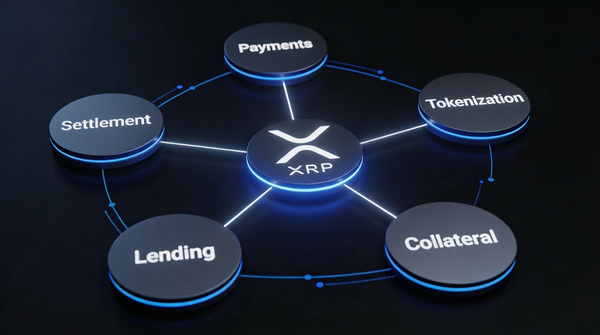
Ripple has spent years building relationships with traditional banks and payment providers, positioning XRP as a bridge currency for cross-border settlements. As institutions demand regulated, compliant crypto infrastructure, Ripple's compliance-first approach may resonate more strongly than during retail-dominated cycles. The company's On-Demand Liquidity service could benefit from the same institutional adoption trends driving Bitcoin's evolution.
However, XRP faces unique dynamics beyond general market trends. The ongoing SEC litigation and regulatory clarity developments will likely affect XRP's price independently of broader institutional adoption patterns. The recent court rulings regarding XRP's legal status have created a complex regulatory environment that institutional investors must navigate carefully.
Additionally, XRP's utility in cross-border payments creates demand drivers separate from Bitcoin's store-of-value narrative. As financial institutions seek faster, cheaper international settlement solutions, XRP's three-second settlement time and low transaction costs provide practical benefits beyond speculative trading.
The shift away from retail-driven volatility toward institutional stability could benefit XRP if Ripple successfully expands its network of banking partnerships. Major institutions like Bank of America, Santander, and SBI Holdings have explored or implemented Ripple's technology, suggesting growing institutional acceptance. Conversely, if the traditional four-year cycle's death means slower, more gradual price appreciation across all cryptocurrencies, XRP investors may need to adjust expectations about rapid price movements typical of previous bull cycles.
Looking Ahead
The consensus among major institutions suggests Bitcoin is entering uncharted territory. Traditional models based on halving cycles appear increasingly irrelevant as ETF flows, regulatory developments, and macroeconomic conditions take precedence.
Whether this represents the complete death of the four-year cycle or merely its evolution remains to be seen. Standard Chartered predicts that breaking the current all-time high of $126,000 in the first half of 2026 will validate their thesis about the cycle's transformation. This would confirm that institutional demand has permanently replaced the halving-driven supply shock as Bitcoin's primary price catalyst.
For investors, this shift demands new analytical frameworks. Rather than timing entries and exits around halving events, success may depend on understanding institutional capital flows, regulatory developments, and broader market liquidity conditions. Tools like ETF flow trackers, on-chain analytics, and institutional sentiment indicators become more relevant than halving countdowns.
The days of predictable post-halving rallies may indeed be over, replaced by a more mature market that behaves increasingly like traditional financial assets. For crypto investors and enthusiasts, the key takeaway is the validation and maturation of digital assets as a legitimate and increasingly stable component of diversified portfolios. This evolution from speculative asset to institutional infrastructure marks cryptocurrency's true arrival in mainstream finance.
DISCLAIMER: This newsletter is for informational purposes only and does not constitute investment advice, advertising, or a recommendation to buy, sell, or hold any securities. This content is not sponsored by or affiliated with any of the mentioned entities. Investments in cryptocurrencies or other financial assets carry significant risks, including the potential for total loss, extreme volatility, and regulatory uncertainty. Past performance is not indicative of future results. Always consult a qualified financial professional and conduct thorough research before making any investment decisions.
Sources
Primary News Sources
- Cathie Wood Interview - Fox Business
- ARK Invest Bitcoin Analysis - Crypto Valley Journal
- Bitcoin Halving Cycle Analysis - Decrypt
- Standard Chartered Research Report - The Block
Institutional Analysis
- Standard Chartered Bitcoin Forecast - Decrypt
- Institutional Bitcoin Adoption - AMBCrypto
- Bitcoin Cycle Analysis - CoinCentral
- Crypto Market Trends - DL News
- Cryptonews Analysis - Yahoo Finance
- Crypto Economy Report
Mainstream Adoption Research
- Bitcoin Institutional Adoption - AInvest
- Institutional Investment Trends - Pinnacle Digest
- Traditional Finance Integration - Amundi Research Center
- Institutional Tsunami Analysis - FinancialContent
- Bitcoin Network Growth - AInvest
- Institutional Crypto Adoption - Blockchain Council
- Bitcoin Adoption Trends - 101 Blockchains
Regulatory and Infrastructure
- Bitcoin ETF Institutional Adoption - Datos Insights
- Blockchain Finance Convergence - AInvest
- Crypto Adoption Index - Chainalysis
- Blockchain Integration Trends - TreasuryXL
- Institutional Cryptocurrency Adoption - Powerdrill
- Traditional Finance Convergence - FinancialContent
- Crypto Mainstream Integration - Fintechnews
- Institutional Digital Assets Survey - EY-Parthenon & Coinbase