Senate Agriculture Committee Advances Crypto Market Structure Bill in Historic 12-11 Vote
Senate Agriculture Committee makes history with 12-11 vote advancing crypto market structure bill—the furthest such legislation has ever progressed. SEC & CFTC chiefs meet today to discuss regulatory harmony. Here's what it means for crypto's future
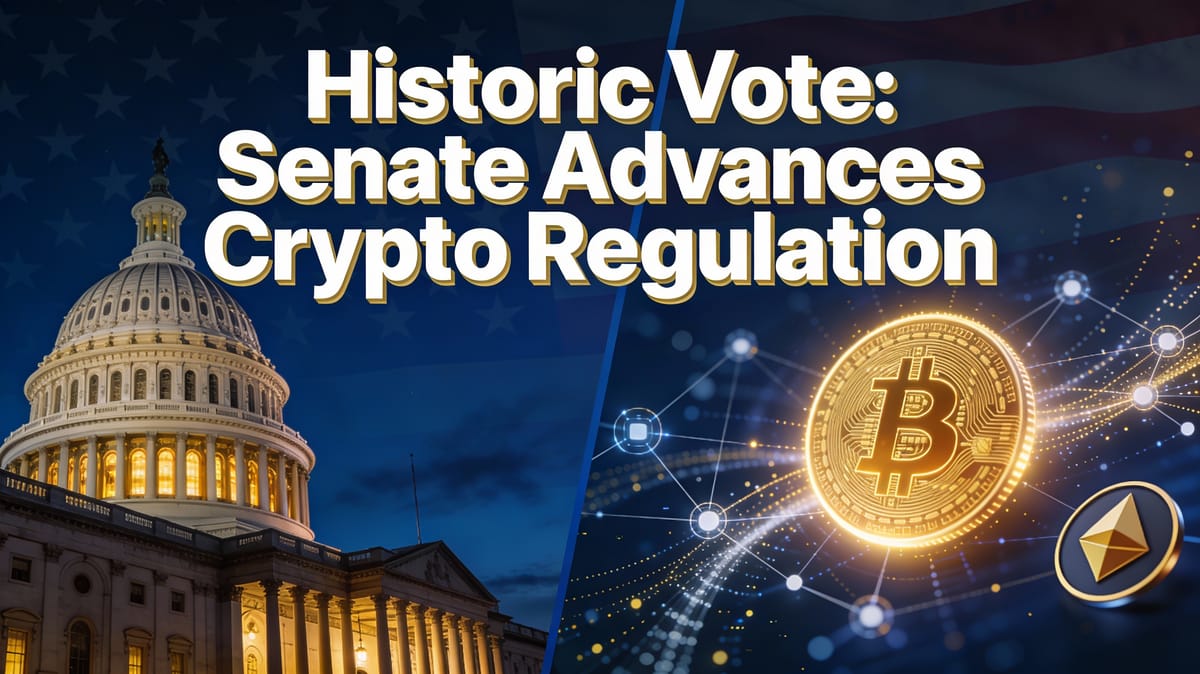
The U.S. Senate Agriculture Committee voted 12-11 along party lines on Thursday, January 29, 2026, to advance the Digital Commodity Intermediaries Act, marking the furthest crypto market structure legislation has ever progressed in the Senate. The historic vote sends the bill to its next phase, though significant hurdles remain before it can become law.
The party-line vote saw all Republicans supporting the measure while every Democrat opposed it, highlighting the partisan divide that continues to challenge comprehensive crypto regulation. Committee Chairman John Boozman (R-Arkansas) pushed forward with the vote after months of bipartisan negotiations failed to produce consensus, while Senator Cory Booker (D-New Jersey), the lead Democratic negotiator, expressed disappointment that Republicans chose to proceed without full agreement.
🇺🇸 The Senate Agriculture Committee passes landmark #crypto market bill. pic.twitter.com/LxpxQS5k0r
— 𝗕𝗮𝗻𝗸XRP (@BankXRP) January 29, 2026
What the Bill Actually Does
The Digital Commodity Intermediaries Act would grant the Commodity Futures Trading Commission (CFTC) primary regulatory authority over digital commodities—blockchain-based assets that are not classified as securities. This represents a major shift in crypto oversight, as the CFTC currently lacks comprehensive authority over spot markets for digital assets.
Under the legislation, digital commodity exchanges, brokers, and dealers would be required to register with the CFTC and comply with new core principles covering trade monitoring, recordkeeping, conflict of interest management, and customer asset protection. The bill would also establish provisional registration pathways to allow existing crypto platforms to continue operating while coming into compliance with new requirements.
Key provisions include:
Registration Requirements: Centralized crypto exchanges like Coinbase, Kraken, and Binance.US would need to register as digital commodity exchanges with the CFTC. Brokers and dealers handling digital commodities would face similar registration obligations.
Customer Protection: The bill prohibits exchanges from commingling their own assets with customer funds, though customers could waive this protection for certain purposes. Exchanges would be required to use qualified digital asset custodians to protect customer holdings.
DeFi Exemptions: Notably, the Agriculture Committee's bill excludes certain decentralized finance (DeFi) activities from its regulatory framework, including operating blockchain nodes, maintaining wallets, and providing interfaces to access blockchain data. This provision aims to protect developers and operators of sufficiently decentralized networks.
Stablecoin Approach: The bill sidesteps controversial stablecoin yield questions by leaving those issues to the GENIUS Act, which became law in 2025 and established a regulatory framework for payment stablecoins.
Regulatory Coordination: SEC and CFTC Harmonization Event
In a significant show of regulatory coordination, SEC Chairman Paul Atkins and CFTC Chairman Michael Selig are holding a joint public event today at CFTC headquarters from 2-3 PM ET to discuss harmonization between the two agencies. The event, titled "SEC – CFTC Harmonization: U.S. Financial Leadership in the Crypto Era," is webcast live and features a fireside chat moderated by Eleanor Terrett, Co-Founder and Host of Crypto in America.
In their joint statement, the chairmen acknowledged that "market participants have been forced to navigate regulatory boundaries that are unclear in application and misaligned in design, based solely on legacy jurisdictional silos." They emphasized that the event "will build on our broader harmonization efforts to ensure that innovation takes root on American soil, under American law, and in service of American investors, consumers, and economic leadership."
This unprecedented collaboration between the SEC and CFTC signals a fundamental shift in how the federal government approaches crypto regulation. The timing of the event—on the same day the Senate Agriculture Committee advanced its crypto bill—underscores the administration's commitment to creating a cohesive regulatory framework for digital assets.
The Road Ahead: Major Obstacles Remain
While Thursday's vote represents historic progress, the bill faces substantial challenges before it can become law. The lack of Democratic support signals that significant revisions may be needed to achieve the bipartisan backing required for Senate passage.
Senate Banking Committee Hurdle: The legislation must still clear the Senate Banking Committee, which oversees the Securities and Exchange Commission and has jurisdiction over more controversial aspects of crypto regulation. That committee postponed its own markup in mid-January after Coinbase withdrew support, citing concerns about tokenized equity restrictions and stablecoin yield provisions.
Reconciliation Process: If both committees eventually pass their respective bills, the two versions must be reconciled into a unified Senate bill. The Senate Banking Committee's version, called the Digital Asset Market Clarity Act, is more comprehensive than the Agriculture Committee's narrower focus on CFTC-regulated commodities.
Democratic Support Required: The combined legislation would need to pass the full Senate, where it requires significant Democratic support to overcome procedural hurdles. At least seven Democratic senators would need to vote in favor for the bill to advance under normal Senate rules.
House Harmonization: After Senate passage, the bill must be harmonized with the House version, which passed 294-134 in July 2025 as the Digital Asset Market Clarity (CLARITY) Act. The House bill included some provisions not present in the Senate version, requiring negotiation between chambers.
Political Headwinds: President Trump has publicly expressed support for crypto market structure legislation, stating he hopes to sign a bill "very soon." However, Democrats raised concerns during Thursday's markup about potential conflicts of interest related to the Trump family's crypto business ventures. Senator Michael Bennett's (D-Colorado) amendment addressing these ethics concerns was rejected 11-12 along party lines.
The legislative calendar adds further pressure. With November midterm elections approaching and ongoing debates about federal funding potentially leading to government shutdowns, the window for passing comprehensive crypto legislation may be narrowing. Industry observers give the bill a 50-60% chance of becoming law in 2026.
Broader Economic Context: Trump to Announce Fed Chair Pick Next Week
Adding another layer to the financial landscape, President Trump announced on Thursday that he intends to reveal his pick to replace Federal Reserve Chair Jerome Powell next week. Treasury Secretary Scott Bessent told Yahoo Finance on Wednesday that "my inclination is we may hear something in the next week or so."
The four finalists to lead the central bank include Kevin Hassett (White House National Economic Council Director), Kevin Warsh (former Fed governor), Christopher Waller (current Fed governor), and Rick Rieder (BlackRock chief of fixed income).
This announcement carries significance for crypto markets beyond just monetary policy. A new Fed chair could influence how traditional financial institutions approach digital assets, particularly as banks increasingly seek to offer crypto services to customers. Lower interest rates—which Trump has consistently advocated for—could also impact crypto market dynamics by making risk assets more attractive to investors.
However, the appointment has become contentious. Republican Senator Tom Tillis (R-North Carolina) has threatened to block Trump's nominee until the Justice Department's criminal investigation into Chair Powell is resolved. Powell's term as chair expires in May 2026, though he could remain as a Fed governor if he chooses.
What This Means for the Crypto Industry
Regulatory Clarity: If enacted, the bill would provide the clearest framework yet for how major cryptocurrencies are regulated in the United States. Assets like Bitcoin, Ethereum, Solana, Cardano, and others classified as digital commodities would fall under CFTC oversight rather than facing potential SEC enforcement as securities.
Exchange Compliance: Centralized exchanges would face new registration requirements and operational standards, but would gain legal certainty about their regulatory obligations. Exchanges that apply for provisional registration would be allowed to continue operating while working toward full compliance, avoiding the risk of sudden enforcement actions.
Institutional Adoption: Clear federal rules could significantly expand corporate and institutional crypto adoption by giving CFOs, treasurers, and compliance officers regulatory predictability. Senator Adam Schiff (D-California) noted during the markup that "we want these jobs, we want this industry to stay in the United States, and that means we need to have rules of the road."
DeFi Protection: The bill's explicit exemptions for certain DeFi activities would protect developers of decentralized protocols from being classified as regulated financial intermediaries, addressing a major concern in the crypto developer community.
Banking Integration: The legislation would allow banks to register as digital commodity brokers or dealers, enabling traditional financial institutions to offer crypto trading, settlement, and custody services to their customers. This could accelerate the integration of crypto into mainstream finance.
Industry Response and Unresolved Issues
The crypto industry has reacted with cautious optimism to Thursday's vote. While the advancement represents the first significant Senate progress on comprehensive crypto regulation, several contentious issues remain unresolved:
Stablecoin Yield Debate: The question of whether stablecoins can offer rewards or yield to holders remains a flashpoint. White House Crypto Czar David Sacks has urged banks to recognize that "yield-related concepts were already addressed in the GENIUS Act" and suggested that "absent market structure legislation, reward mechanisms would likely emerge regardless."
Tokenized Securities: Concerns about restrictions on tokenized equities led Coinbase to withdraw support for the Senate Banking Committee's version. The company argued that the draft contained "a de facto ban on tokenized equities" and shifted too much regulatory power from the CFTC to the SEC.
Regulatory Balance: Finding the right balance between CFTC and SEC authority continues to divide stakeholders. Some crypto companies prefer CFTC oversight as more innovation-friendly, while investor protection advocates argue that SEC oversight is necessary for certain digital assets.
Government Ethics: Democratic concerns about government officials profiting from crypto holdings while setting policy remain unaddressed in the Agriculture Committee's bill, potentially complicating efforts to secure bipartisan support.
Next Steps
The White House plans to host a meeting next week aimed at finding common ground among crypto companies, traditional banking interests, Republican and Democratic lawmakers, and administration officials. These negotiations will be critical to determining whether a compromise bill can ultimately pass both chambers with bipartisan support.
Meanwhile, Treasury Secretary Scott Bessent confirmed that seized Bitcoin will be retained as part of a federal digital asset reserve, and CFTC Chairman Selig announced an initiative to comprehensively review the agency's existing rules to ensure "a level playing field for new entrants and incumbents alike."
Looking Forward
Thursday's vote marks a significant milestone in the multi-year effort to establish clear federal regulation for cryptocurrency markets. The convergence of legislative progress, regulatory harmonization between the SEC and CFTC, and the upcoming Fed chair announcement signals that 2026 could be a transformative year for crypto's integration into the U.S. financial system.
However, the partisan nature of the Agriculture Committee vote and unresolved disputes between the Senate's two committees suggest that considerable work remains before comprehensive crypto market structure legislation becomes law. The next few weeks will be critical as lawmakers attempt to bridge divides on contentious issues and determine whether bipartisan compromise is possible.
With the crypto industry pushing for clarity, traditional financial institutions lobbying to protect their interests, and the Trump administration prioritizing making the United States "the crypto capital of the world," the final form of any legislation—if it passes at all—may look significantly different from what the Agriculture Committee advanced on Thursday.
For now, crypto markets continue to operate under a patchwork of state regulations, federal enforcement actions, and regulatory guidance rather than comprehensive federal legislation. Whether 2026 becomes the year that changes remains to be seen, but today's developments represent the most significant progress toward that goal in the industry's history.
Sources
- CoinDesk: Crypto bill clears U.S. Senate milestone
- CoinDesk: Live blog - Senate Agriculture Committee advances crypto bill
- SEC: SEC-CFTC Harmonization Event
- Yahoo Finance: Trump could announce Fed chair nominee next week
- Reuters: Trump plans to announce Fed chairman choice next week
- Davis Wright Tremaine: Senate Ag Committee Releases Updated Crypto Market Structure Text
- Congress.gov: Crypto Legislation Overview - CLARITY Act
- Latham & Watkins: US Crypto Policy Tracker - Legislative Developments
- Senate Banking Committee: Chairman Scott Announces Digital Asset Market Structure Markup
- Paul Hastings: Senate Agriculture Releases Market Structure Bill
- CNBC: Sen. Gillibrand 'optimistic' Senate Agriculture will advance crypto bill
- The Block: Midterms, shutdown risks and negotiations
- Hunton Andrews Kurth: Senate Releases Crypto Market Structure Bills
- Blockchain Council: Crypto CLARITY Act
- De Silva Law Offices: The Crypto Market Bill Explained
- Chapman and Cutler: Mid-Summer Developments in Crypto Legislation
- LegalBison: Understanding the Clarity Bill
- PYMNTS: Senate Sets January Markups for Crypto Market Regulation
- Congress.gov: H.R.3633 - Digital Asset Market Clarity Act of 2025
- National Law Review: Senate Releases Crypto Market Structure Bills
- Quartz: Trump's timeline for announcing new Fed chair changes again
DISCLAIMER: This newsletter is for informational purposes only and does not constitute investment advice, advertising, or a recommendation to buy, sell, or hold any securities. This content is not sponsored by or affiliated with any of the mentioned entities. Investments in cryptocurrencies or other financial assets carry significant risks, including the potential for total loss, extreme volatility, and regulatory uncertainty. Past performance is not indicative of future results. Always consult a qualified financial professional and conduct thorough research before making any investment decisions.