Ripple's New Whitepaper Lays Out the Future of Institutional Crypto Trading
Ripple just published a bold whitepaper laying out how banks and hedge funds should be trading crypto — and the XRP Ledger is right at the center of the solution. Here's what's confirmed, what it means for institutions, and what it could mean for XRP.
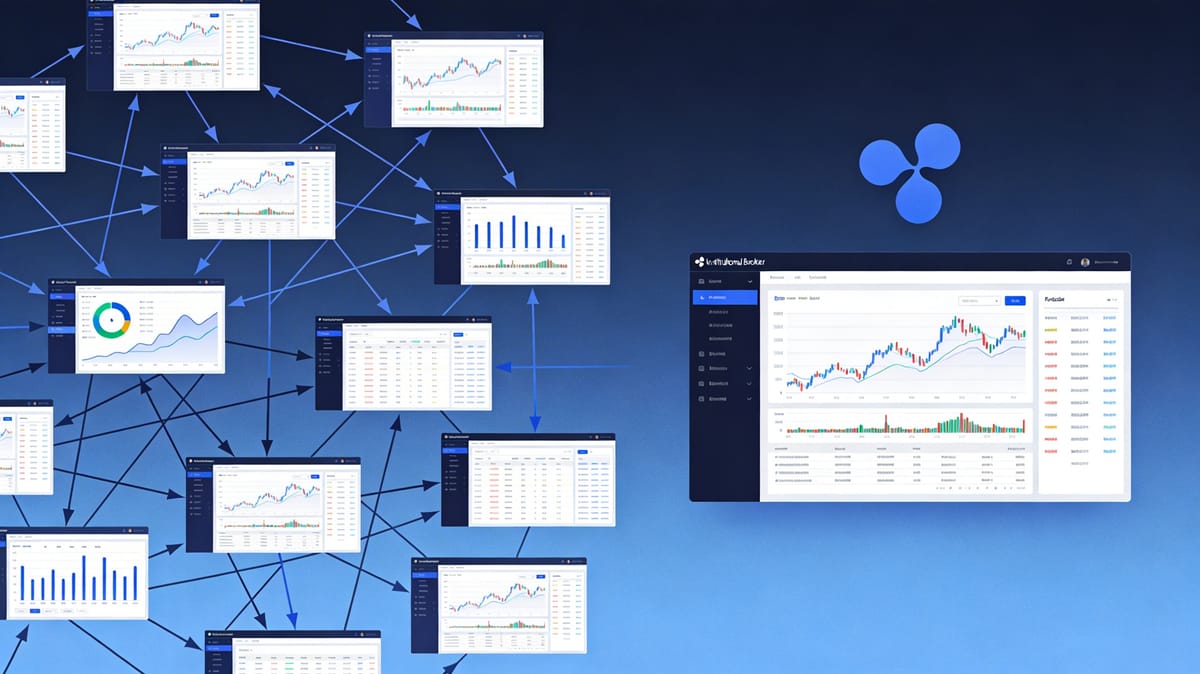
Ripple has published a framework it believes could reshape how banks, hedge funds, and major institutions access digital asset markets — and the XRP Ledger plays a key supporting role.
Ripple's new whitepaper, titled The Blueprint for Institutional Digital Assets Trading, argues that the institutional crypto market still lacks the settlement, credit, and risk infrastructure needed to support large-scale participation. The paper calls for a Digital Prime Brokerage (DPB) model built around centralized credit intermediation, aggregated liquidity, and T+1 net settlement — the same mechanics that underpin mature traditional financial markets. While the whitepaper is a structural proposal, not a product announcement, it arrives at a moment when Ripple has already begun building exactly this kind of infrastructure in the real world.
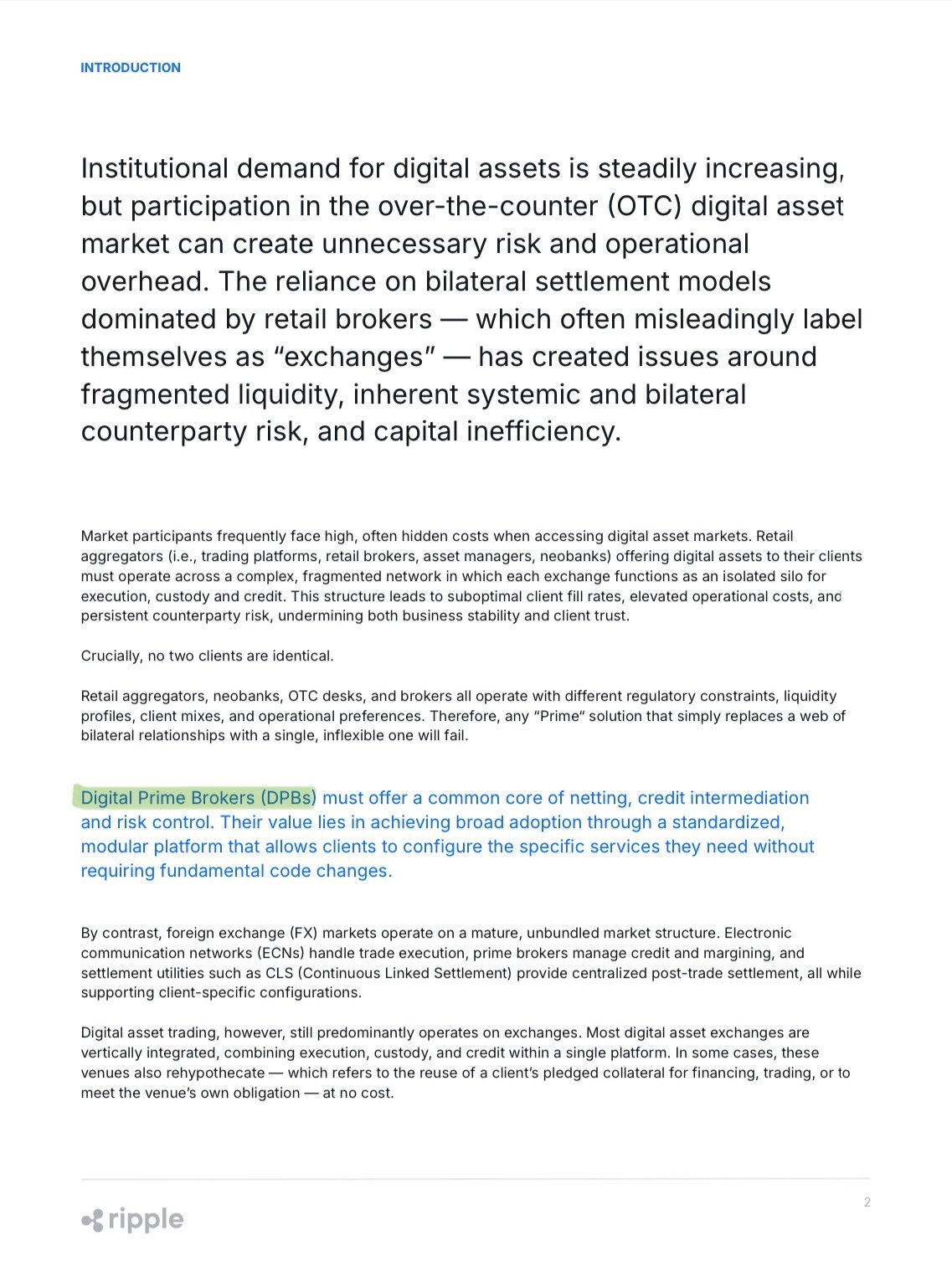
The Problem: Crypto's Institutional "Infrastructure Tax"
Anyone who has watched institutions try to navigate crypto markets knows the friction involved. Right now, a hedge fund or bank trading digital assets must open accounts across multiple exchanges, maintain separate credit lines at each venue, pre-fund positions in full, and absorb the risk that one failed platform — think FTX or Celsius — could freeze assets across their entire operation.
Ripple's whitepaper argues the current market still relies on gross settlement or full prefunding, which forces repeated intraday asset transfers and leaves collateral stranded across exchanges. In one illustrative example, it notes that a client buying 100 BTC and selling 80 BTC during the same trading cycle would only need to settle 20 BTC net under a T+1 model — cutting gross fund movements by roughly 89%.
That is not a minor operational footnote. For institutions managing hundreds of millions in positions, that capital efficiency gap represents enormous locked-up cost.
Ripple's Managing Director for Middle East & Africa, Reece Merrick, announced the whitepaper on X, stating: "Traditional finance meets digital assets, but the bridge can still be a little shaky. Managing a matrix of exchanges and bilateral risks isn't just a headache, it's an inefficiency tax on your capital."
The Solution: The Digital Prime Broker (DPB) Model
The core proposal of the whitepaper is straightforward in concept, though significant in implication. Under the DPB framework, a client would execute one master agreement with a prime broker, while trades done with approved liquidity providers and market makers would be given up to that broker. Ripple argues this replaces a web of bilateral exposures with a single contractual counterparty, simplifying legal, compliance, and settlement workflows while reducing failure risk across venues.
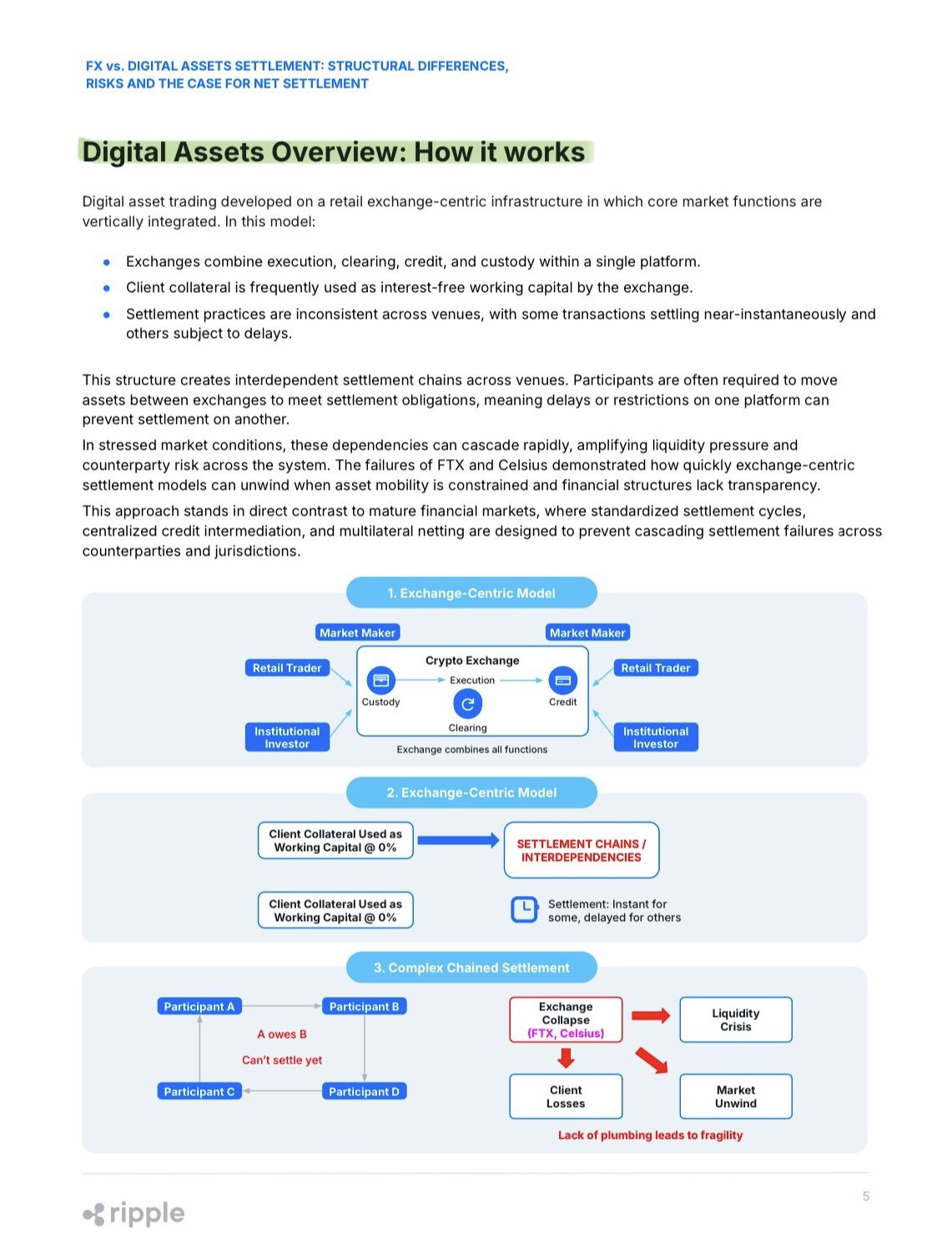
This is not a new idea in traditional finance. Foreign exchange and equities markets already operate this way — prime brokers sit between clients and liquidity venues, netting positions, managing credit, and providing a single point of accountability. Ripple's argument is simply that crypto has not yet built this layer, and until it does, institutional participation will remain structurally constrained.
Outside support for the framework came from XTX Markets COO Mike Irwin, who wrote: "A Digital Prime Brokerage model will enable institutional participants, including retail aggregators, to reduce operational risk, unlock trapped capital, and scale growth. As clients increasingly favor net-settled, prime-based structures, liquidity providers and venues will have to adapt. Adoption, however, will depend on prime brokers supporting specific client needs and constraints rather than enforcing a rigid, one-size-fits-all model."
Where XRP and the XRPL Fit In
It would be inaccurate to call this an "XRP announcement." The whitepaper's main thesis is about market structure reform at a systemic level — not about XRP specifically. That said, the XRP Ledger does appear as a meaningful piece of the proposed architecture.
Ripple says the XRP Ledger could support early settlement through on-chain credit lines that fund obligations ahead of the standard T+1 net settlement cycle, with funding costs charged transparently to the party requesting early liquidity. That makes XRP part of the proposed plumbing, but the whitepaper's main thesis is broader: institutional crypto still needs better market structure before it can look more like mature financial markets.
In other words: XRPL is positioned as an efficiency layer within a larger institutional framework — not as the headline. That framing is consistent with Ripple's broader strategy and gives the proposal real-world grounding.
The Real-World Build: Ripple Prime
What distinguishes this whitepaper from a theoretical exercise is that Ripple has already made billion-dollar bets in precisely this direction. In April 2025, Ripple agreed to acquire multi-asset prime brokerage firm Hidden Road for $1.25 billion — one of the largest M&A deals in digital asset industry history. Ripple CEO Brad Garlinghouse stated: "With the U.S. market finally opening up and digital assets maturing for institutional adoption, this is an inflection point."
Ripple completed the acquisition in October 2025 and launched the resulting platform — Ripple Prime — as the first global, multi-asset prime broker owned by a crypto company, offering OTC spot trading for major digital assets including XRP and RLUSD, with U.S. institutions able to cross-margin spot, swaps, and futures positions under one platform.
Ripple Prime now clears over $3 trillion annually across markets and serves more than 300 institutional customers. The whitepaper's DPB model, in essence, describes the architecture that Ripple Prime is already beginning to operationalize.
XRP/Ripple: What This Means
For XRP holders and Ripple watchers, the whitepaper matters for several interconnected reasons.
Institutional positioning: The whitepaper signals that Ripple is seeking deeper engagement with institutional market structure rather than focusing solely on payment use cases or retail-oriented products. If the DPB model gains traction, it could strengthen Ripple's value proposition with trading firms and support higher enterprise adoption of its broader technology stack.
XRPL utility narrative: By placing the XRP Ledger within the settlement layer of a DPB model — even in a supporting role — Ripple is actively building the case that XRPL is infrastructure for institutional DeFi, not just a payments rail. Ripple and XRPL contributors have outlined a growing set of "institutional DeFi" building blocks on the XRP Ledger designed to make the network viable for regulated financial activity, combining compliance-focused infrastructure with XRP's role as a settlement and bridge asset.
RLUSD integration: Hidden Road — now Ripple Prime — was structured to use RLUSD as collateral across its prime brokerage products, making RLUSD the first stablecoin to enable efficient cross-margining between digital assets and traditional markets. A DPB model that gains broader industry adoption would expand RLUSD's real-world utility substantially.
It's worth noting that while the DPB whitepaper is a framework Ripple is advocating for, broad adoption would require buy-in from competing prime brokers, liquidity venues, and regulators. The paper describes what Ripple believes should happen — not what has been agreed upon across the industry. That remains a meaningful distinction.
Key Takeaways
Ripple's Blueprint for Institutional Digital Assets Trading is a serious and well-sourced argument for why crypto market structure needs to mature — and it arrives backed by Ripple's $1.25 billion acquisition of Hidden Road, now operating as Ripple Prime. The XRP Ledger's role in the proposed framework is real but supporting, not central. Whether the broader industry coalesces around a Digital Prime Broker model remains to be seen, but the direction Ripple is moving — toward institutional-grade infrastructure, credit intermediation, and net settlement — is clear, deliberate, and now on paper.
DISCLAIMER: This newsletter is for informational purposes only and does not constitute investment advice, advertising, or a recommendation to buy, sell, or hold any securities. This content is not sponsored by or affiliated with any of the mentioned entities. Investments in cryptocurrencies or other financial assets carry significant risks, including the potential for total loss, extreme volatility, and regulatory uncertainty. Past performance is not indicative of future results. Always consult a qualified financial professional and conduct thorough research before making any investment decisions.
Sources
Ripple Whitepaper Coverage — Bitcoinist
TipRanks: Ripple Promotes Digital Prime Broker Framework
CoinDesk: Ripple Acquires Hidden Road for $1.25B
Fortune: Ripple-Hidden Road Acquisition Details
Bloomberg: Ripple to Acquire Hidden Road for $1.25 Billion
BusinessWire: Ripple Launches Ripple Prime for U.S. Market
CoinDesk: Ripple Launches Ripple Prime
Ripple.com: Ripple Prime Overview
CoinDesk: Ripple Lays Out Institutional DeFi Blueprint for XRPL
Hidden Road Press Release: Ripple Acquisition Announcement
Ripple.com: Building the One-Stop Shop for Digital Asset Infrastructure