Ripple Pushes SEC for Rights-Based Crypto Rules Ahead of Key Senate Vote
Ripple submits groundbreaking letter to SEC Crypto Task Force days before critical Senate vote, calling for rights-based framework over "decentralization" test. Could this reshape XRP's regulatory future?
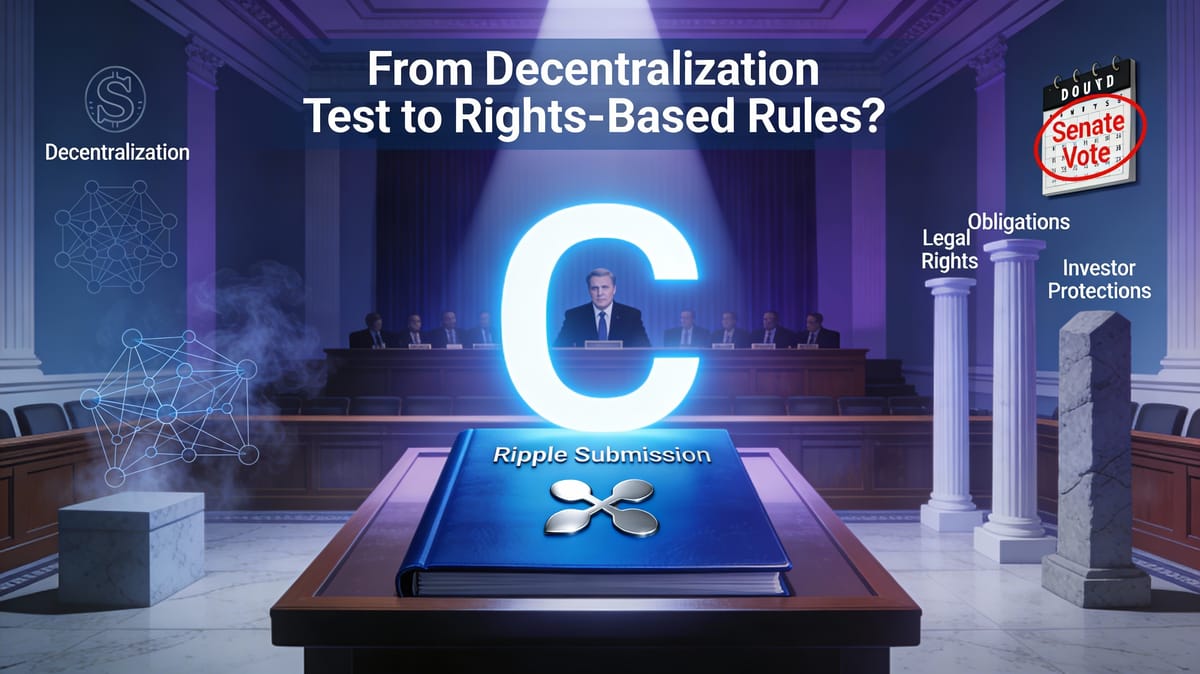
Ripple Labs has submitted a comprehensive letter to the SEC's Crypto Task Force calling for a fundamental shift in how digital assets are regulated, timing the move strategically just days before crucial Senate committee votes that could reshape the entire U.S. cryptocurrency landscape.
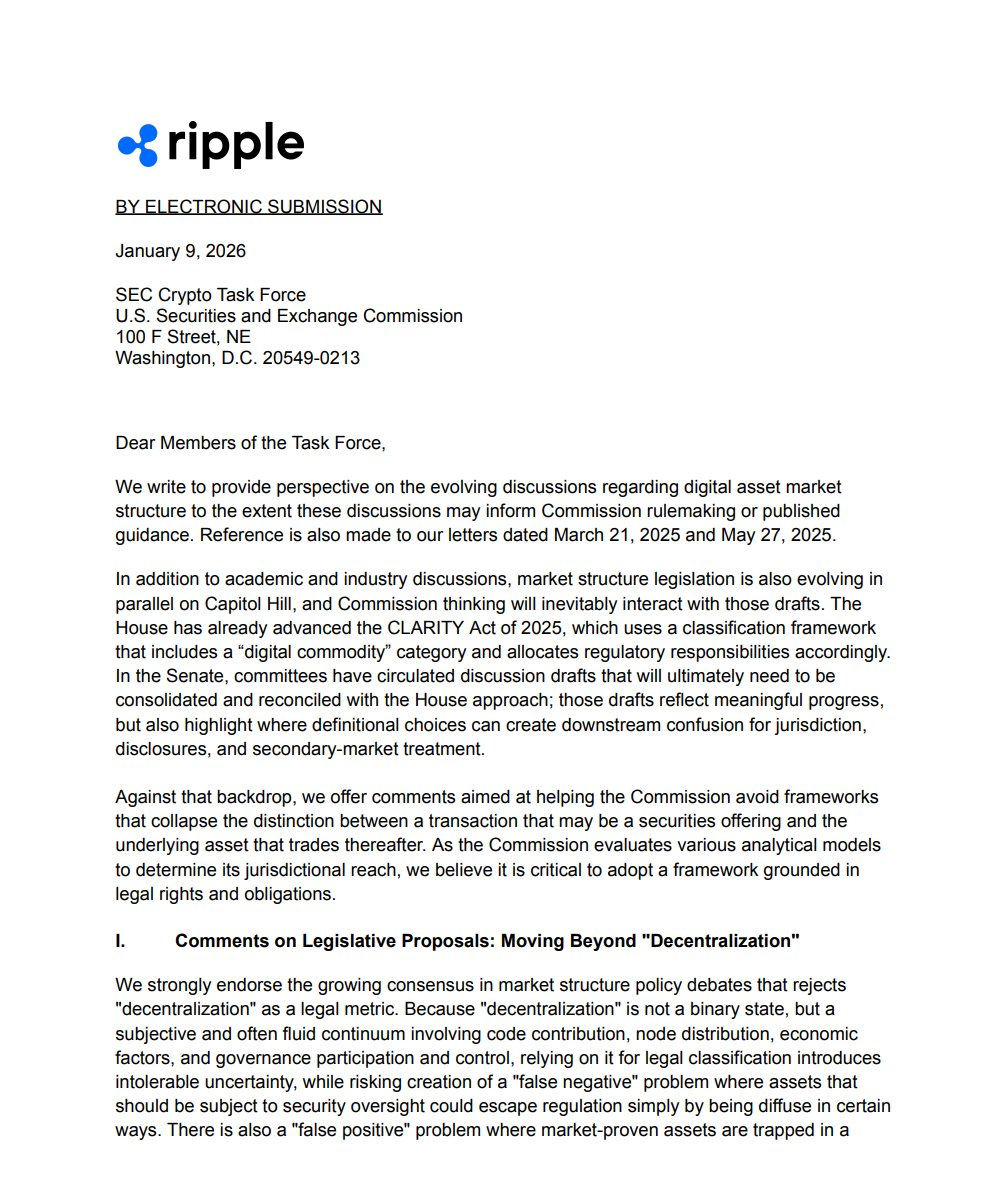
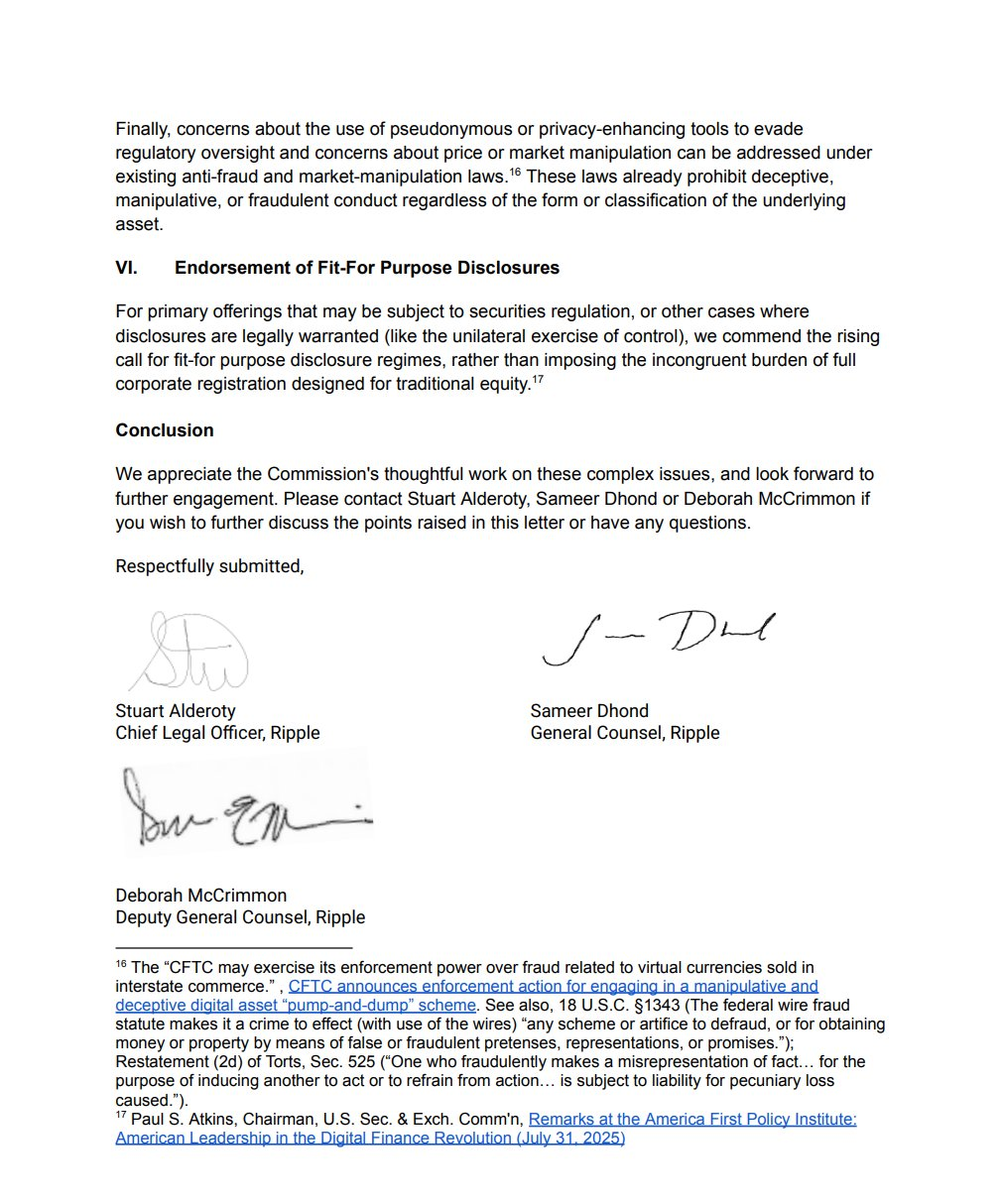
In the January 9, 2026 submission to the SEC Crypto Task Force, Chief Legal Officer Stuart Alderoty, General Counsel Sameer Dhond, and Deputy General Counsel Deborah McCrimmon outlined Ripple's position that regulators should move beyond the increasingly controversial "decentralization" test and instead focus on enforceable contractual rights and obligations to determine whether a digital asset falls under securities law.
"In addition to academic and industry discussions, market structure legislation is also moving in the same direction," the letter states. "Notably, as it relates to public discourse in the United States the Howey test itself focuses on whether buyers have been promised returns, not on the secondary market activities of the issuer."
Timing Aligns With Critical Legislative Moment
The timing of Ripple's submission is particularly significant. Senate Banking Committee Chairman Tim Scott (R-S.C.) announced on January 10, 2026, that comprehensive digital asset market structure legislation would face a committee markup on Wednesday, January 15, 2026—just six days after Ripple filed its letter.
"This legislation is about making America the crypto capital of the world – so the next generation of jobs and innovation is built here, not overseas," Scott stated in the announcement.
However, as of January 13, 2026, some reports indicate the markup may be delayed to late January as lawmakers work to secure broader bipartisan support. Both the Senate Banking Committee and Senate Agriculture Committee would need to pass aligned versions before the legislation can advance to a full Senate vote.
Ripple's Core Argument: Rights Over Decentralization
The heart of Ripple's submission challenges the use of "decentralization" as a regulatory metric. According to the letter, decentralization exists on a spectrum influenced by multiple factors, including code contributions, node distribution, economic incentives, and governance participation.
Ripple argues this subjectivity creates "uncertainty, legal risk, and inconsistent outcomes." The company warns this approach can produce both "false negatives," where assets that should be regulated avoid oversight by appearing diffuse, and "false positives," where established assets remain trapped in securities regulations despite having functional utility.
Instead, Ripple advocates for what it calls a "privity" standard—focusing on whether there is a direct contractual relationship between a seller and buyer involving primary distribution. According to the submission, once an issuer's specific promises have been "fulfilled, failed, or terminated," the securities law relationship should naturally expire.
"The issuer is simply a seller of inventory into an active marketplace of many buyers and sellers, economically analogous to an oil company selling barrels," the letter states. "Purchasers in this secondary market rely on liquidity, demand, market sentiment, price arbitrage, and/or existing utility, not on new promises."
What This Could Mean for XRP
For XRP specifically, Ripple's framework could provide clearer pathways for institutional adoption and broader market participation. The company explicitly references the 2023 Torres ruling in SEC v. Ripple Labs, which held that certain institutional sales were investment contracts but that secondary market sales and programmatic sales were not securities transactions.
This distinction forms a key part of Ripple's argument that tokens should be evaluated separately from the offerings in which they were sold. The letter positions this approach as consistent with recent remarks by SEC Commissioner Hester Peirce, who in her May 19, 2025 "New Paradigm" speech asked: "When does a non-security crypto asset that was once part of an investment contract become separated from that contract?"
As of January 13, 2026, XRP is trading at approximately $2.05, defending key psychological support levels after a seven-day decline from its January 6 peak of $2.357. The cryptocurrency has experienced significant volatility despite Ripple's legal victories and growing institutional infrastructure.
Regulatory Landscape Context
Ripple's letter arrives in a dramatically different regulatory environment than existed during most of its SEC litigation. The SEC lawsuit concluded in August 2025 when both parties dismissed their appeals, with Ripple ultimately paying $50 million—96% less than the SEC's original $2 billion demand.
The settlement also included an unprecedented "bad actor" waiver under Regulation D, effectively clearing Ripple of the disqualifications that would have restricted its ability to raise capital through certain private offerings.
Current SEC Chair Paul Atkins, who replaced Gary Gensler in the Trump administration, has signaled a shift toward clearer rulemaking rather than enforcement-first approaches. In his November 12, 2025 address, Atkins emphasized that "investment contract" describes a legal relationship between parties rather than an "unremovable label attached to an object."
Industry-Wide Implications
Ripple's submission extends beyond XRP to address broader industry concerns. The letter warns against treating every token with active secondary trading as perpetually subject to securities oversight, comparing high-velocity crypto markets to spot commodities like gold and silver.
The company argues that without clear separation between offerings and assets, regulators create what it calls "Zombie Promises"—situations where securities obligations persist indefinitely even after the original contractual promises have been fulfilled or failed.
"Capital raising has a scope and boundary," the letter states. "It involves specific transactions between identifiable parties in which money flows to an entity in exchange for a stake, rights, or expectations tied to that entity's future efforts."
Industry lobbying efforts have intensified ahead of the Senate markups, with The Digital Chamber flying more than 50 industry participants to Washington to meet with senators. The organization's CEO Cody Carbone described the goal as showing "there is industry support to move this bill forward" and demonstrating industry participants can serve as "a resource for every single Senate office."
Unresolved Legislative Challenges
Despite momentum, significant sticking points remain in the Senate negotiations. Reports from Politico indicate ongoing debates over:
- Ethics provisions aimed at preventing conflicts of interest
- Stablecoin yield restrictions and whether crypto firms can offer yield-bearing products that compete with traditional banks
- Leadership appointments at the SEC and CFTC
- DeFi liability standards and regulatory jurisdiction between agencies
The Banking Committee version reportedly seeks to create a new term for "ancillary assets" to clarify which cryptocurrencies are not securities, while the Agriculture Committee draft would grant expanded authority to the CFTC for commodities oversight.
Market Response and Analyst Views
Despite significant regulatory progress, XRP has faced headwinds. The token reached $3.66 in early 2025 but dropped 13% from its January 6 peak, experiencing its worst seven-day losing streak in two months.
Technical analysts point to resistance at the 200-day exponential moving average around $2.56, which XRP has rejected three times in recent months. Some analysts, like Damian Chmiel, warn of potential further correction toward $1.90-$1.80 support levels if the $2.00 psychological barrier breaks.
However, on-chain metrics tell a different story. U.Today reported that the XRP Ledger recently recorded its highest payment count in about 180 days, with daily transactions reaching approximately 1.45 million—a structural indication that network usage is increasing even as price consolidates.
Institutional infrastructure continues to expand. Seven XRP spot ETFs launched in November 2025 and accumulated $1.14 billion in assets within six weeks, with Franklin Templeton's involvement particularly significant as it provides 13,000 financial advisors access to XRP exposure.
Looking Ahead
The next several weeks will prove critical for both Ripple and the broader cryptocurrency industry. If the Senate committees successfully advance market structure legislation—whether on January 15 or later in the month—and if that legislation incorporates principles similar to those Ripple advocates, it could establish the regulatory clarity that has eluded the industry for years.
However, even with legislative progress, questions remain about whether clear rules will translate to token value appreciation. As some analysts have noted, XRP's challenge isn't just regulatory clarity but demonstrating that network utility drives sustainable token demand.
Ripple's letter represents a sophisticated legal and policy argument that regulators should evaluate obligations rather than objects, time-bound oversight rather than perpetual jurisdiction, and recognize when contractual promises naturally expire. Whether this framework ultimately shapes the SEC's approach—and congressional legislation—will become clearer in the coming weeks as both regulatory guidance and legislative texts take final form.
Sources
- SEC.gov - Ripple Letter to Crypto Task Force (January 9, 2026)
- Senate Banking Committee - Chairman Scott Announces Digital Asset Market Structure Markup
- The Cryptonomist - Ripple SEC Letter Recasts Token Jurisdiction for XRP
- Bitcoinist - Ripple Sends New Letter To SEC: What It Could Mean For XRP
- PYMNTS - Senate Sets January Markups for Crypto Market Regulation
- The Hill - Crypto industry ramps up Senate lobbying ahead of key committee votes
- TradingView - Why XRP Is Falling? 7-Day Drop Raises Risk of Another 40% XRP Price Decline
- U.Today - XRP: New Record in 2026 Set
- Coin Edition - XRP Price Prediction 2026: SEC Victory and $1.14B ETF Flows Target $5-$8
- The National Law Review - This is Finally the End: The Ripple Case Concludes as Predicted
- SEC.gov - Ripple Submission to Crypto Task Force (March 21, 2025)
- Coincub - Ripple vs SEC: Full Case Timeline, Rulings, and 2025 Settlement
- YCharts - XRP Price (Daily)
DISCLAIMER: This newsletter is for informational purposes only and does not constitute investment advice, advertising, or a recommendation to buy, sell, or hold any securities. This content is not sponsored by or affiliated with any of the mentioned entities. Investments in cryptocurrencies or other financial assets carry significant risks, including the potential for total loss, extreme volatility, and regulatory uncertainty. Past performance is not indicative of future results. Always consult a qualified financial professional and conduct thorough research before making any investment decisions.