Ripple Prime Integrates Hyperliquid in First DeFi Expansion for Institutional Clients
Ripple Prime integrates Hyperliquid, marking its first DeFi expansion. Institutional clients can now access on-chain derivatives liquidity while cross-margining with traditional assets in one unified prime brokerage framework.
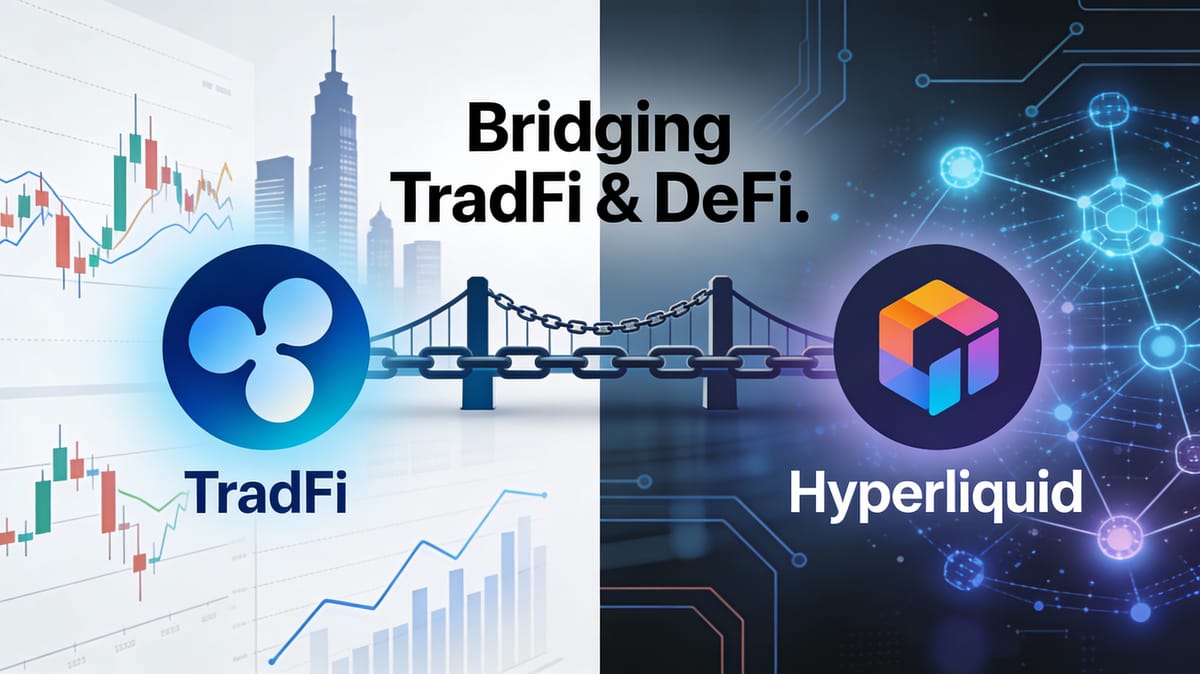
Ripple has taken a significant step into decentralized finance by announcing that Ripple Prime, its multi-asset institutional prime brokerage platform, now supports Hyperliquid, the leading decentralized derivatives protocol. This marks Ripple Prime's first DeFi integration since Ripple completed its $1.25 billion acquisition of Hidden Road last year, positioning the company to bridge traditional finance and on-chain markets at institutional scale.
The announcement enables institutional clients to access Hyperliquid's on-chain derivatives liquidity while cross-margining their DeFi exposures alongside all other asset classes supported by Ripple Prime, including digital assets, foreign exchange, fixed income, OTC swaps, and cleared derivatives.
What the Integration Delivers
Ripple Prime clients can now tap into Hyperliquid's deep liquidity pools through a unified prime brokerage framework. The integration provides institutions with a single counterparty relationship, centralized risk management, and consolidated margin across their entire portfolio rather than having to manage multiple platform relationships and separate collateral pools.
Michael Higgins, International CEO of Ripple Prime, emphasized the strategic significance of this expansion. "At Ripple Prime, we are excited to continue leading the way in merging decentralized finance with traditional prime brokerage services, offering direct support to trading, yield generation and a wider range of digital assets," Higgins stated. "This strategic extension of our prime brokerage platform into DeFi will enhance our clients' access to liquidity, providing the greater efficiency and innovation that our institutional clients demand."
Why Hyperliquid Matters
Hyperliquid has rapidly established itself as the dominant force in decentralized perpetual futures trading. The protocol has captured approximately 80% of the decentralized perpetuals market share, surpassing $5 billion in open interest and processing over $200 billion in monthly trading volume. The platform's trading volume now represents about 14% of Binance's derivatives volume, a notable achievement for a decentralized venue.
Built on its own Layer-1 blockchain with a proprietary consensus mechanism called HyperBFT, Hyperliquid processes up to 200,000 transactions per second with sub-second confirmation times. The platform combines the speed of centralized exchanges with self-custodial benefits, allowing traders to maintain control of their assets while accessing advanced derivatives instruments.
Hyperliquid's recent HIP-3 upgrade expanded its offerings to include customized perpetuals for stocks and commodities, with over 300 development teams currently building on the HyperEVM infrastructure.
XRP and Ripple Ecosystem Impact
The integration carries specific relevance for the XRP ecosystem. Hyperliquid already supports XRP perpetual futures alongside BTC and ETH products, making XRP one of the most actively traded assets on the platform. Earlier this year, Flare Network launched FXRP on Hyperliquid, marking the first time XRP spot exposure became available on the decentralized exchange.
XRPL developer Bird explained the significance of the announcement on X, describing Ripple Prime as a secure, all-in-one financial dashboard for institutional players while Hyperliquid serves as the high-performance on-chain trading engine. The integration means institutions can trade advanced crypto products on-chain without managing multiple platforms or additional counterparty risk.
For Ripple, the move complements its broader institutional strategy following the Hidden Road acquisition, which made it the first crypto company to own and operate a global, multi-asset prime broker. Since that acquisition closed in October 2025, Ripple Prime's business has reportedly grown threefold.
Market Implications
This integration arrives as institutional participation in DeFi continues accelerating. Traditional finance institutions have increasingly sought regulated pathways to access decentralized markets, and Ripple Prime's Hyperliquid integration provides exactly that framework, combining on-chain access with the compliance controls and capital efficiency expected from a global prime broker.
The partnership also demonstrates the growing convergence between centralized and decentralized financial infrastructure. Rather than viewing DeFi as a competitive threat, major players like Ripple are finding ways to offer institutional clients the benefits of both worlds: the liquidity and innovation of decentralized protocols alongside the risk management and regulatory compliance of traditional brokerage services.
For the broader crypto market, the development signals continued maturation of institutional-grade infrastructure. As more prime brokers integrate DeFi protocols, the barrier to institutional capital entering on-chain markets continues to lower, potentially driving increased liquidity and adoption across the ecosystem.
DISCLAIMER: This newsletter is for informational purposes only and does not constitute investment advice, advertising, or a recommendation to buy, sell, or hold any securities. This content is not sponsored by or affiliated with any of the mentioned entities. Investments in cryptocurrencies or other financial assets carry significant risks, including the potential for total loss, extreme volatility, and regulatory uncertainty. Past performance is not indicative of future results. Always consult a qualified financial professional and conduct thorough research before making any investment decisions.
Sources
Ripple. (2026, February 4). Ripple Announces Support for Hyperliquid, Expanding Institutional Access to Onchain Liquidity. Ripple Press Releases.
https://ripple.com/ripple-press/ripple-announces-support-for-hyperliquid-expanding-institutional-access-to-onchain-liquidity/
CoinDesk. (2026, February 4). Ripple's prime brokerage platform adds support for decentralized exchange Hyperliquid. CoinDesk Business.
https://www.coindesk.com/business/2026/02/04/ripple-s-prime-brokerage-platform-adds-support-for-decentralized-exchange-hyperliquid
Hidden Road. (2025, April). Ripple Agrees to Acquire Prime Broker Hidden Road for $1.25B in One of the Largest Deals in the Digital Assets Space. Hidden Road Press Release.
https://hiddenroad.com/ripple-agrees-to-acquire-prime-broker-hidden-road-for-1-25b-in-one-of-the-largest-deals-in-the-digital-assets-space/
Ripple. (2025, October). It's Prime Time: Ripple Closes Hidden Road Acquisition to Bring Prime Brokerage into the Digital Age. Ripple Insights.
https://ripple.com/insights/ripple-closes-hidden-road-acquisition/
The Block. (2025, August 29). Hyperliquid chips away at Binance's derivatives dominance as volume ratio nears 14%. The Block.
https://www.theblock.co/post/368674/hyperliquid-captures-80-of-decentralized-perps-market-chipping-away-at-binance
Ledger Academy. (2025, November 7). What Is Hyperliquid? Ledger.
https://www.ledger.com/academy/topics/blockchain/what-is-hyperliquid
CoinLedger. (2025). What Is Hyperliquid? CoinLedger Learn.
https://coinledger.io/learn/what-is-hyperliquid
The Block. (2026, January). Flare launches first XRP spot exposure on Hyperliquid via FXRP. The Block.
https://www.theblock.co/post/384671/flare-xrp-spot-hyperliquid-fxrp
Ripple. (2026). Prime Brokerage: Ripple Prime. Ripple Solutions.
https://ripple.com/solutions/prime-brokerage/