OCC Green Lights Banks as Crypto Intermediaries: What "Riskless Principal" Transactions Mean for Digital Assets
The OCC confirms U.S. banks can now facilitate crypto transactions as intermediaries. Interpretive Letter 1188 allows 'riskless principal' trades—banks match buyers and sellers without holding crypto on balance sheets. A major step toward regulated digital asset integration.

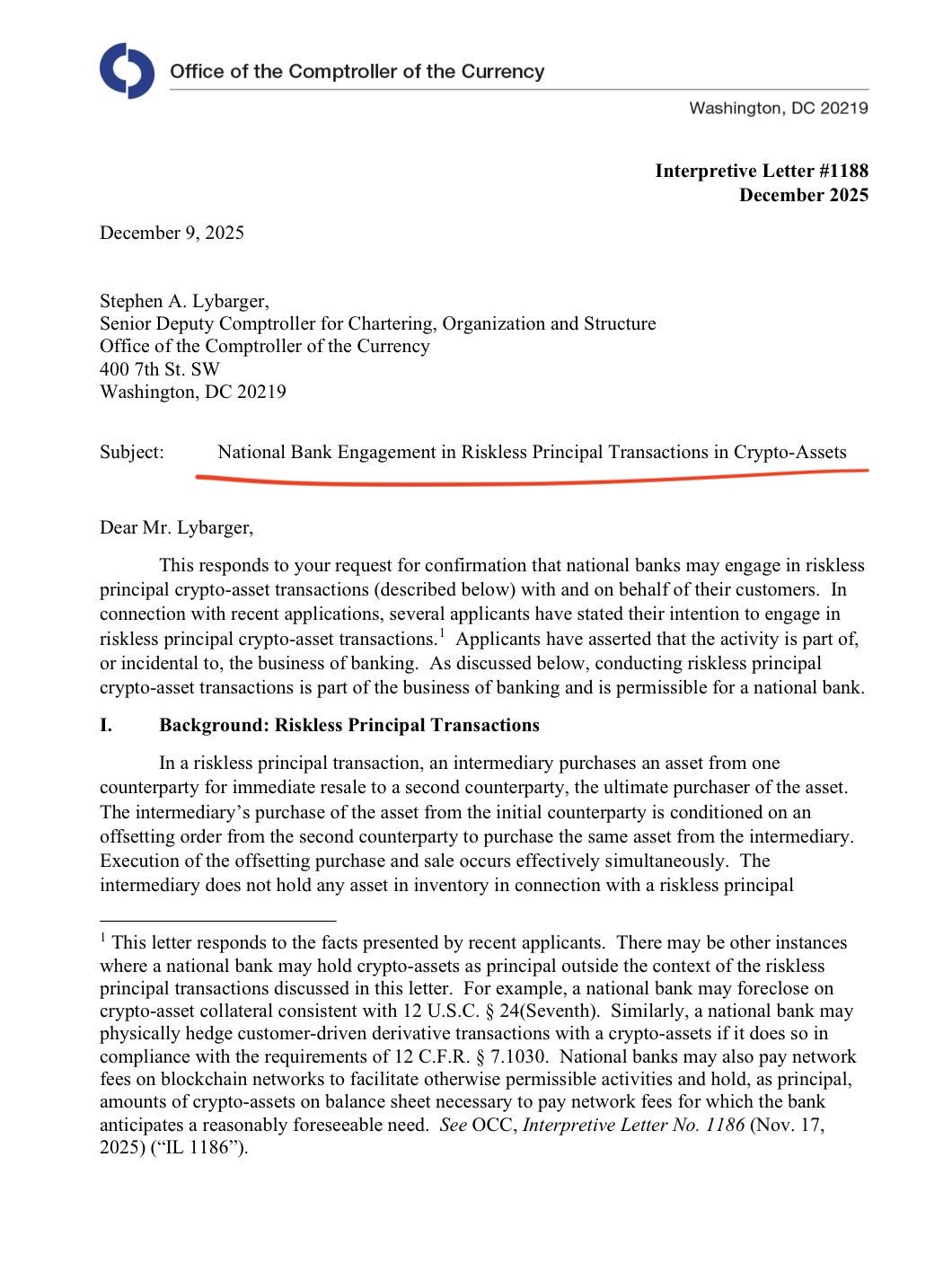
The U.S. Office of the Comptroller of the Currency has officially confirmed that national banks can facilitate cryptocurrency transactions as intermediaries, marking a pivotal shift in how traditional financial institutions may engage with digital assets. Released December 9, 2025, Interpretive Letter 1188 clarifies that banks can conduct "riskless principal" crypto transactions—essentially acting as brokers between customers without holding digital assets on their balance sheets.
What Are Riskless Principal Transactions?
In a riskless principal transaction, a bank purchases a crypto asset from one customer while simultaneously entering into an offsetting transaction with another customer. The bank serves as an intermediary but doesn't hold the crypto assets in inventory, functioning in a capacity equivalent to a broker acting as an agent.
According to American Banker, "banks neutralize their market risk through offsetting transactions but retain credit risk due primarily to the ongoing financial obligations of the parties to the transaction." In the event of a settlement default, banks would face limited market risk but would typically have procedures in place to sell the crypto assets as soon as possible.
Why This Matters: Bringing Crypto Into Regulated Banking
This guidance represents more than just technical clarification—it signals a shift from treating crypto as an exception to recognizing its role inside the existing banking framework. By treating crypto brokerage as normal banking activity, the OCC is signaling that regulated intermediaries are now expected to participate in digital asset markets rather than avoid them.
The OCC emphasized that banks can participate in crypto custody and related services without prior supervisory non-objection, encouraging responsible innovation in the digital asset space.
Competitive Implications
Currently, customers seeking to trade cryptocurrencies typically turn to specialized exchanges like Coinbase, Kraken, or Binance. This new framework means customers can transact in crypto assets through established national banks, providing a more regulated environment compared to exchanges that operate outside the purview of strict financial oversight.
This creates room for banks to design client-facing crypto products under supervisory oversight rather than pushing customers toward offshore exchanges or unregulated platforms.
Legal Basis: The "Business of Banking"
The OCC's letter distinguishes between crypto assets that are securities and those that are not. Riskless principal transactions in crypto assets classified as securities are already permissible under existing law, as banks act without recourse, meaning they don't assume customer risk.
The OCC extends this reasoning to crypto assets that are not securities, framing the activity as part of the broader "business of banking." Under U.S. law, the business of banking is not narrowly defined, allowing banks to engage in new activities that logically extend their traditional functions.
The OCC analyzed the activity using four factors: its similarity to recognized banking activities, its benefit to banks and customers, the nature of risks involved, and whether state-chartered banks are authorized to perform it. The agency concluded that riskless principal crypto transactions align with traditional brokerage and custody services, benefit customers by providing regulated access to crypto assets, and carry risks familiar to banks, such as settlement risk.
Risk Management Requirements
While the guidance opens doors for bank participation in crypto markets, the OCC made clear that banks must conduct these activities in a safe and sound manner and in compliance with applicable law.
Different facts and circumstances could result in different conclusions. Banks face settlement risk, counterparty credit risk, and operational risks when facilitating crypto transactions. The OCC noted that in the event of settlement failures, banks would need procedures to liquidate crypto assets quickly.
Broader Regulatory Context
This interpretive letter doesn't exist in isolation. The guidance arrives just one day after the Commodity Futures Trading Commission launched a pilot program allowing Bitcoin, Ethereum, and USDC to be used as collateral in U.S. derivatives markets. That initiative also withdrew older guidance now considered outdated under the GENIUS Act and introduced formal guardrails for tokenized settlement, custody, and capital requirements.
Together, the OCC and CFTC developments signal a coordinated regulatory approach aimed at bringing crypto trading, settlement, and collateral inside U.S. market infrastructure rather than leaving it to offshore venues.
Historical Progression
The OCC's regulatory approach builds on earlier guidance beginning with Interpretive Letter 1170 in 2020, which allowed banks to offer crypto custody services. In March 2025, the OCC removed prior requirements for banks to seek advance approval before engaging in certain crypto operations, signaling growing acceptance of digital assets in mainstream finance.
What This Doesn't Allow
It's crucial to understand the limitations of this guidance:
Banks cannot:
- Hold cryptocurrency as proprietary investments
- Speculate on crypto price movements
- Maintain substantial crypto inventory on their balance sheets for extended periods
- Trade crypto for their own profit
The "riskless principal" framework specifically requires that transactions be customer-driven with immediate offsetting, eliminating the bank's market exposure to crypto price volatility.
Market Implications
This regulatory clarity could have several significant effects on the crypto market:
Institutional legitimacy: Traditional banks entering the crypto brokerage space lends institutional credibility to digital assets and could accelerate mainstream adoption.
Regulatory arbitrage reduction: By bringing crypto services under federal banking supervision, the guidance could reduce regulatory fragmentation and create more consistent standards across the industry.
Competition with crypto exchanges: Banks now have a clear path to compete with specialized crypto platforms, potentially offering customers integrated services combining traditional banking with digital asset access.
Enhanced consumer protection: Customers transacting through federally regulated banks may benefit from established banking consumer protection frameworks, deposit insurance for fiat portions of transactions, and robust compliance infrastructure.
Looking Ahead
Comptroller Jonathan Gould has been highlighting the value of bringing nonbanks, including digital asset-focused firms, into the regulatory fold through national trust charter applications. This suggests continued regulatory evolution toward integrating digital assets into the traditional financial system rather than treating them as separate, parallel infrastructure.
The combination of recent OCC and CFTC actions indicates U.S. regulators are moving from enforcement-focused approaches toward integration, positioning tokenization and digital assets within the supervisory perimeter. This shift could enhance safety, reduce reliance on foreign exchange markets, and accelerate institutional adoption by providing familiar regulatory treatment.
Key Takeaways
- National banks can now act as intermediaries in crypto transactions without holding digital assets as inventory
- This applies to customer-driven transactions where banks match buyers and sellers
- Banks must manage settlement risk, credit risk, and maintain appropriate controls
- The guidance represents regulatory evolution toward integrating crypto into traditional banking rather than excluding it
- Combined with recent CFTC actions, this signals coordinated movement toward regulated onshore crypto markets
DISCLAIMER: This newsletter is for informational purposes only and does not constitute investment advice, advertising, or a recommendation to buy, sell, or hold any securities. This content is not sponsored by or affiliated with any of the mentioned entities. Investments in cryptocurrencies or other financial assets carry significant risks, including the potential for total loss, extreme volatility, and regulatory uncertainty. Past performance is not indicative of future results. Always consult a qualified financial professional and conduct thorough research before making any investment decisions.
Sources
- Office of the Comptroller of the Currency - Interpretive Letter 1188
- American Banker - OCC says banks may broker crypto assets for customers
- AMBCrypto - U.S. banks can now broker Bitcoin, Ethereum, XRP, and Solana trades
- Bitcoinist - US Banks Cleared For 'Riskless' Crypto Transactions Following OCC Letter
- Bitcoin Ethereum News - U.S. OCC Allows Banks 'Riskless' Crypto Trading Role
- CryptoBriefing - OCC confirms banks can execute riskless principal crypto transactions
- Bitcoin Ethereum News - OCC Approves Banks As Intermediaries In Crypto Transactions