Japan's Bond Market Sparks $640M Crypto Exodus: Why XRP Bulls See Opportunity in Chaos
Japan's bond yields hit 17-year highs, triggering a $640M crypto liquidation as the reverse carry trade begins. Jake Claver boldly predicts "$1000 XRP" as efficient settlement assets gain value from Japan's capital repatriation. A seismic shift is reshaping global finance.
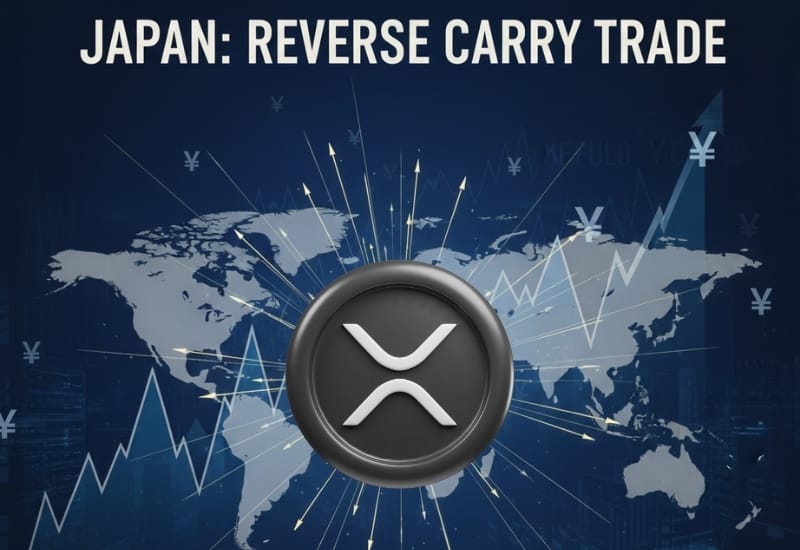
Japan's 10-year government bond yields spiked to 1.84%, their highest level since April 2008, triggering what analysts are calling the beginning of a "reverse carry trade" that could fundamentally reshape global capital flows. As more than 217,000 traders were liquidated, resulting in a loss of almost $640 million in positions, some crypto leaders see opportunity amid the chaos.
The dramatic shift has crypto executives like Jake Claver making bold predictions. When Robert Kiyosaki warned about impending market deflation due to Japan's policy reversal, Claver replied, "I'll take XRP for $1000, Bob"—a statement that's gaining attention as Japan's monetary pivot creates new demand for efficient cross-border payment systems.
I'll take XRP for $1000, Bob https://t.co/pWUN9xidM8
— Jake Claver, QFOP (@beyond_broke) November 30, 2025
The Great Reversal: From Carry Trade to Capital Repatriation
For three decades, the yen carry trade saw investors borrow cheaply in yen and deploy capital into higher-yielding assets abroad, including US Treasuries, European bonds, and cryptocurrencies. Now, with Bank of Japan Governor Kazuo Ueda signaling a possible interest rate hike at the December 18-19 monetary policy meeting, the flow is reversing.
Japanese institutions hold around $1.1 trillion in U.S. Treasuries. As yields rose 0.07 percentage points in a single session to 1.88%, the economics of keeping money overseas shifted dramatically. Japan's move away from decades of low interest rates makes efficient settlement assets more valuable, according to analysts tracking the transition.
The scale is staggering. Analysts estimate the yen carry trade's size at up to $14 trillion—over three times the cryptocurrency market capitalization. This isn't just unwinding; it's reversing direction entirely.
XRP's Japan Connection: More Than Coincidence
While most cryptocurrencies suffered in the selloff, XRP's unique position in Japan's financial ecosystem deserves attention. XRP emerged as a statistical anomaly, initially rallying 7.6% on the day at $2.02 before broader market forces took hold.
SBI Remit's use of XRP for faster cross-border payments represents more than a pilot program—it's a working example of how efficient settlement assets could benefit from Japan's new monetary regime. The Bank for International Settlements (BIS) recommends that settlement assets should turn over 8–10 times per day to support modern financial rails, a benchmark XRP consistently exceeds.
American analyst Bri Teresi highlighted the connection, noting that XRP's speed and programmability align with the infrastructure needs created by Japan's monetary shift. As capital flows reverse direction, the demand for rapid, low-cost settlement could accelerate.
The Domino Theory: Claver's Bold Prediction
Jake Claver's "$1000 XRP" prediction isn't happening in isolation. Claver recently revealed that XRP spot ETFs have already begun "eating through" OTC and dark-pool supply far faster than anticipated. His theory suggests multiple catalysts are converging:
First, supply absorption: ETF-driven demand is reducing available XRP supply while institutional adoption grows.
Second, liquidity demand: As the reverse carry trade accelerates, institutions need efficient ways to move capital across borders quickly and cheaply.
Third, regulatory clarity: XRP's established regulatory position in key markets positions it advantageously as traditional finance seeks crypto exposure.
While such price targets remain highly speculative, some analysts maintain that four-digit XRP valuations may not appear until 2040, tempering expectations of immediate dramatic gains.
Bond Market Shock Waves
The immediate impact on crypto was severe. Bitcoin fell 5.2% to $86,062 and Ethereum dropped 5.4% to $2,826 as the unwinding of the yen carry trade threatened to "drain liquidity from the system".
The two-year rate, sensitive to monetary policy expectations, rose 3 basis points to 1.02%, while market forecasts suggest the BOJ's policy rate could reach 1.4% following three 25-basis-point hikes.
The timing coincided with institutional movements. Large sell orders reportedly came from major players, including Binance, Wintermute, and BlackRock, with more than $2.5 billion in BTC allegedly offloaded in just three hours.
XRP Technical Outlook: Testing Key Levels
Despite initial resilience, XRP couldn't escape the broader selloff. XRP is trading around $2.0–$2.1, down roughly 6–7% over the past 24 hours. A close below $2.04 — the lower range of recent consolidation — could invite deeper selling pressure, pushing XRP toward $1.85 or even $1.65.
However, reclaiming $2.20 could signal the start of a short-term rebound toward $2.40, though technical indicators currently favor continued pressure.
Key levels to watch:
- Support: $2.04, then $1.85-$1.65
- Resistance: $2.20, then $2.40-$2.60
- Critical break: $2.445–$2.460 represents roughly 1.7 billion XRP in realized supply and has repeatedly acted as a ceiling
The Ripple Effect: Institutional Infrastructure Play
Beyond price speculation, Ripple's strategic positioning deserves attention. In April 2025, Ripple announced it would acquire prime broker Hidden Road for about $1.25 billion, making Ripple the first crypto company to own a global, multi-asset prime broker.
Hidden Road clears roughly $3 trillion in trading volume annually for over 300 institutional clients, offering services such as securities lending, collateral management and trade execution. The rebranded "Ripple Prime" platform explicitly connects traditional finance with XRP Ledger settlement.
This infrastructure play becomes more relevant as Japan's reverse carry trade creates new cross-border capital flow patterns requiring efficient settlement solutions.
What the Experts Are Watching
The broader implications extend beyond crypto. Matt Maley, chief market strategist at Miller Tabak + Co, warned that unwinding carry trades "would drain liquidity from the system" and "would not be good for the stock market".
However, some see the transition as necessary. As one analyst noted, "For 30 years, the Yen Carry Trade subsidized global arrogance — zero rates… free leverage… fake growth… entire economies built on borrowed time and borrowed money. Now Japan has reversed the switch".
Key Takeaways
Japan's reverse carry trade represents a seismic shift from three decades of capital export to potential capital repatriation. While this creates near-term volatility across risk assets, it also generates new demand for efficient cross-border settlement infrastructure.
XRP's established presence in Japan's payments ecosystem, combined with Ripple's expanding institutional infrastructure, positions it uniquely for this transition. However, investors should note that while the fundamental thesis is compelling, the path to dramatically higher prices remains speculative and highly dependent on broader market adoption.
The next few months will reveal whether Japan's monetary pivot creates the sustained capital flow reversal that bulls like Claver anticipate, or whether traditional market forces reassert control.
DISCLAIMER: This newsletter is for informational purposes only and does not constitute investment advice, advertising, or a recommendation to buy, sell, or hold any securities. This content is not sponsored by or affiliated with any of the mentioned entities. Investments in cryptocurrencies or other financial assets carry significant risks, including the potential for total loss, extreme volatility, and regulatory uncertainty. Past performance is not indicative of future results. Always consult a qualified financial professional and conduct thorough research before making any investment decisions.
Sources
Financial Market Data:
- Nikkei Asia. (2025, December 1). "2-year Japan government bond yields rise above 1% on BOJ hike speculation." Retrieved from https://asia.nikkei.com/business/markets/bonds/2-year-japan-government-bond-yields-rise-above-1-on-boj-hike-speculation
- Trading Economics. (2025, December 1). "Japan 10 Year Government Bond Yield." Retrieved from https://tradingeconomics.com/japan/government-bond-yield
- Bloomberg. (2025, December 1). "Japan's Two-Year Bond Yield Reaches 1% for First Time Since 2008." Retrieved from https://www.bloomberg.com/news/articles/2025-12-01/japan-two-year-note-yield-rises-to-1-for-first-time-since-2008
Cryptocurrency Market Analysis:
- BeInCrypto. (2025, December 1). "Japan's Bond Breakout Threatens the Crypto Market, $640M Lost." Retrieved from https://beincrypto.com/japan-bond-yield-surge-crypto-liquidation/
- BeInCrypto. (2025, December 1). "Yen Carry Crypto Trading Over? Japan Signals Rate Hike." Retrieved from https://beincrypto.com/japan-bond-yield-rate-hike-2024/
- Bitcoin Ethereum News. (2025, December 1). "Japan's Surging Bond Yields May Unwind Yen Carry Trade, Pressuring Bitcoin." Retrieved from https://bitcoinethereumnews.com/bitcoin/japans-surging-bond-yields-may-unwind-yen-carry-trade-pressuring-bitcoin/
XRP and Market Commentary:
- The Crypto Basic. (2025, December 1). "Top CEO Says 'I'll Take XRP for $1,000' as Kiyosaki's Warns Traditional Markets to Deflate." Retrieved from https://thecryptobasic.com/2025/12/01/top-ceo-says-ill-take-xrp-for-1000-as-kiyosakis-warns-traditional-markets-to-deflate/
- TS2 Space. (2025, December 1). "XRP Price Today, December 1, 2025: 7% Drop Tests Key Support as ETFs, Stablecoin News and AI Models Clash on Forecasts." Retrieved from https://ts2.tech/en/xrp-price-today-december-1-2025-7-drop-tests-key-support-as-etfs-stablecoin-news-and-ai-models-clash-on-forecasts/
- CryptoTicker. (2025, December 1). "Will XRP Price Crash Further or Rebound Soon?" Retrieved from https://cryptoticker.io/en/will-xrp-price-crash-further-or-rebound-soon/
Market Analysis and Commentary:
- CoinEdition. (2025, December 1). "Asian Markets Trigger $646M Crypto Shakeout: $83K BTC Next?" Retrieved from https://coinedition.com/asian-markets-trigger-646-million-liquidations-crypto-83k-btc-next/
- CoinPedia. (2025, December 1). "Crypto News Today [Live] Updates On Dec 1,2025: Crypto Crash, Bitcoin ATM, 21 Share XRP ETF, Ethereum Price, Crypto Liquidations." Retrieved from https://coinpedia.org/news/why-crypto-is-going-down-today-live-updates-on-dec-1-2025/
- CNN Business. (2025, December 1). "Crypto remains on edge. That could be bad news for the stock market." Retrieved from https://us.cnn.com/2025/12/01/economy/us-stock-market-bitcoin-yen
- Yahoo Finance. (2025, December 1). "Japan's Bond Shock Slams Crypto: $640 Million Liquidated as 10-Year JGB Hits 17-Year High." Retrieved from https://finance.yahoo.com/news/japan-bond-shock-slams-crypto-075745746.html
- Yahoo Finance. (2025, October 10). "Could a Yen Carry Trade Unwind Become the Next Black Swan Event?" Retrieved from https://finance.yahoo.com/news/could-yen-carry-trade-unwind-073733311.html