Grant Cardone's Bitcoin–Real Estate Hybrid: Are Concepts Like This A Potential Blueprint For Debt-Created Inflation?
As U.S. debt nears $36 trillion, Grant Cardone's hybrid fund uses apartment rents to buy Bitcoin—testing whether productive assets can hedge persistent inflation. Is this a workable blueprint for debt-driven debasement, or one investor's risky bet?

As U.S. public debt approaches $36 trillion and interest costs continue climbing, a growing number of investors are asking whether persistent inflation—rather than fiscal discipline or outright default—has become the most politically viable path forward. If that macro thesis proves even partially correct, what does a practical defensive strategy actually look like?
Grant Cardone's new hybrid Bitcoin–real estate fund offers one institutional answer: use inflation-sensitive rental income to systematically accumulate strictly scarce digital collateral. While Cardone's specific structure may not be replicable for most individual investors, the core logic raises a provocative question: could concepts like this represent a workable blueprint for positioning against debt-driven currency debasement?
The Macro Case: Why Debt-Created Inflation Matters
Macro research from firms like DACFP and market analysts emphasizes that high and rising U.S. public debt, elevated interest costs, and limited political appetite for real fiscal tightening increase the odds that policymakers lean on persistent, above-target inflation rather than explicit default or severe spending cuts.
Under that scenario:
Fiat cash and long-duration bonds steadily lose purchasing power in real terms, eroding the value of traditional savings.
Alternative, non-sovereign stores of value such as Bitcoin, real assets, and commodities may absorb a growing share of capital seeking to preserve purchasing power.
Real estate with pricing power (especially multifamily housing in supply-constrained markets) tends to function as a semi-inflation hedge, with rents and nominal property values generally rising alongside the price level over long horizons.
The question becomes: if inflation persists structurally above central bank targets for years, how do you position a portfolio to not just survive, but potentially benefit from that environment?
Cardone's Answer: Real Estate Cash Flow Buys Bitcoin
Grant Cardone has long been a prominent real estate syndicator, but he historically treated Bitcoin as speculative and kept it at the portfolio edges. Over the past two years, that stance has reversed. Cardone now argues publicly that Bitcoin is superior to gold as a long-term store of value and has been aggressively adding BTC during market drawdowns.
The new hybrid fund formalizes that pivot. Cardone Capital has launched a vehicle built around large multifamily properties where rental income is systematically directed into Bitcoin purchases rather than being fully distributed as cash. Public coverage describes structures such as an approximately debt-free multifamily asset with millions in annual net operating income earmarked to dollar-cost average into BTC, alongside a larger $235 million hybrid fund with a dedicated Bitcoin sleeve.
What Makes This Structure Unusual
Anchored in operating cash flows: Unlike crypto funds that rely on trading profits or capital calls, this strategy is built on real tenant rents—predictable, recurring income from productive real estate.
Rules-based Bitcoin accumulation: A fixed percentage of net operating income is automatically allocated to periodic Bitcoin purchases, removing emotion and timing risk from the equation.
Long-term treasury model: Cardone has signaled ambitions to eventually take such mixed hard-asset vehicles public, providing liquidity while maintaining the systematic accumulation approach.
The design fuses two inflation-resistant ideas into one capital stack:
- Real estate operates as the inflation-sensitive cash-flow engine that benefits when nominal rents rise with the price level.
- Bitcoin serves as the scarce, non-sovereign collateral that may benefit disproportionately if currency debasement accelerates.
Crucially, the fund doesn't rely on investors' wage income or idle cash to buy BTC. It converts nominally inflating rental flows—already partially insulated from inflation—into a growing stack of unlevered Bitcoin over time.
Is This Actually A Blueprint, Or Just One Man's Bet?
The more interesting question isn't whether Cardone's specific fund succeeds, but whether the underlying logic holds up as a general framework for individual investors facing the same macro environment.
The Theoretical Appeal
If the "inflate the debt away" path is the most likely political outcome, then:
Productive assets that pass through inflation (rental properties, businesses with pricing power, certain equities) maintain or grow their nominal cash flows.
Scarce, non-sovereign collateral (Bitcoin, gold, hard commodities) may appreciate as fiat purchasing power erodes and savers seek alternatives.
Combining both lets you use one to systematically accumulate the other, without betting the farm on either. If inflation stays elevated, you're buying more scarce collateral with inflating income. If it doesn't, you still own productive real assets with intrinsic cash flow.
The Practical Challenges
This is not a risk-free "have your cake and eat it too" strategy. Several failure modes are worth considering:
Benign macro outcome: If the U.S. delivers credible fiscal consolidation and maintains low, stable inflation, Bitcoin's specific "debasement hedge" advantage weakens significantly. You're left running a high-volatility crypto sleeve funded by real assets, and a traditional diversified portfolio might outperform.
Real-asset underperformance: Local real estate can be hammered by demographics, regulation, financing constraints, or poor execution. If your cash-flow engine sputters—whether it's a rental property, small business, or dividend stocks—the systematic accumulation strategy breaks down.
Crypto-specific risks: Tightening regulation, adverse court rulings, protocol failures, or superior competing technologies could impair Bitcoin's upside. Aggressive allocations then risk underperforming simpler hard-asset strategies.
Execution and discipline: Most individual investors struggle with systematic, rules-based strategies over multi-year periods. Emotional decisions during drawdowns or bull runs can undermine the entire approach.
So while the concept has theoretical merit, it requires honest assessment of whether you can execute it prudently and whether both halves of the strategy can survive extended periods where the macro thesis looks "wrong."
Could Individuals Mirror This Approach?
For individuals who find the logic compelling, the challenge is translating an institutional structure into something appropriately sized and risk-managed. Here's a potential framework (not financial advice):
1. Anchor in inflation-resistant productive assets
Instead of Cardone's multifamily empire, this could be:
- A small rental property with positive cash flow
- A closely held business with pricing power
- High-quality dividend stocks or REITs that historically pass through inflation
The key is that the asset generates recurring free cash flow and has some historical track record of maintaining real purchasing power during inflationary periods.
2. Automate a disciplined DCA program
Rather than ad-hoc, emotion-driven crypto buying:
- Commit a fixed percentage of net free cash flow (after all expenses, taxes, reserves, and debt service) to periodic Bitcoin or other crypto purchases
- Set a schedule (monthly, quarterly) and stick to it regardless of price
- Think of it as a systematic rebalancing from inflation-sensitive income to scarce collateral
3. Keep the crypto sleeve unlevered
Cardone's structure emphasizes using unlevered or conservatively leveraged property cash flow to buy BTC outright, which eliminates forced-liquidation risk during drawdowns. For individuals:
- Own crypto outright, no margin or rehypothecation
- Never borrow short-term money to buy crypto
- Fund purchases only from genuine free cash flow, not principal or emergency reserves
4. Size for survivability, not maximum upside
Allocations should be calibrated so that:
- A prolonged crypto bear market doesn't wreck your financial life
- A real estate or business downturn doesn't force crypto sales at the worst time
- You can maintain the strategy for 5-10+ years even if it looks foolish in year 2 or 3
If the macro thesis plays out—persistent deficits, structurally higher inflation, and capital migration toward non-fiat assets—this approach aims to systematically increase your holdings of scarce collateral without relying solely on wage income. If it doesn't, you still own productive assets and can treat the crypto sleeve as a satellite position rather than an existential bet.
The Institutional Flip: When Skeptics Become Architects
What makes Cardone's strategy more interesting is that it's part of a much broader pattern: some of traditional finance's loudest Bitcoin skeptics have quietly become structural buyers, architects, or distributors of crypto exposure. This institutional pivot reinforces the macro thesis that debt-heavy, inflation-prone systems are pushing capital toward alternatives.
Larry Fink: From "Money Laundering" To Infrastructure Builder
BlackRock CEO Larry Fink spent most of the 2010s dismissing Bitcoin as a tool for money launderers. By 2020, he began acknowledging it had "captured the imagination" of investors. Since 2023, the shift has gone fully structural.
BlackRock's iShares Bitcoin Trust (IBIT) became one of the fastest-growing ETFs in history, now holding tens of billions in assets. Fink now publicly frames Bitcoin as a "flight to quality" hedge and has placed tokenization of traditional assets on public blockchains at the center of BlackRock's long-term strategy.
Where Cardone uses real estate cash flow to buy Bitcoin directly, Fink is building the institutional plumbing: regulated spot ETFs, tokenized money-market funds, and on-chain representations of bonds and real assets. Same trade, different execution layer.
Other Prominent Reversals
Jamie Dimon / JPMorgan: Called Bitcoin a "fraud" publicly, yet JPMorgan now publishes research comparing Bitcoin favorably to gold, has launched structured notes tied to BlackRock's Bitcoin ETF, and experiments with blockchain settlement via JPM Coin.
Vanguard: The most conservative major fund house historically banned crypto ETFs as "too speculative." In December 2024, Vanguard quietly began allowing trading of regulated crypto ETFs in response to overwhelming client demand.
Institutional allocators broadly: Professional investor surveys now show majorities planning to expand or maintain crypto exposure, with Bitcoin spot ETFs collectively holding over $100 billion.
These aren't fringe players or crypto natives. These are the pillars of traditional finance—firms that benefit enormously from the current debt-based fiat system—now building profit centers around the very assets that stand to benefit if that system faces persistent inflation pressure.
What This Means For The Blueprint
The institutional conversions matter for several reasons:
Normalization: When BlackRock, JPMorgan, and Vanguard treat Bitcoin as legitimate treasury or portfolio collateral, it reduces career risk for smaller allocators considering similar strategies.
Infrastructure: Spot ETFs and tokenized funds make it operationally easier to implement systematic DCA programs from retirement accounts and brokerage platforms.
Incentive alignment: If the asset managers who benefit most from financialized fiat systems are building businesses around Bitcoin and tokenization, it suggests they see structural demand—not just a speculative bubble.
For individuals considering a Cardone-style approach, this institutional backdrop provides more confidence that the trade isn't purely contrarian speculation, but a position that major allocators are increasingly structuring their businesses around.
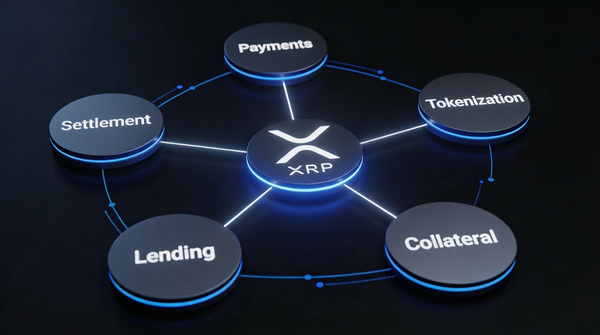
XRP / Ripple: Where Does Cross-Border Settlement Fit?
Although Cardone's fund is explicitly Bitcoin-focused, the underlying logic—using productive assets to accumulate non-sovereign digital collateral—naturally extends to other crypto assets with different use cases.
XRP and Bitcoin occupy fundamentally different niches. Bitcoin is positioned as digital gold and a pure store of value. XRP is designed as a bridge currency for cross-border payments and liquidity management. But both are framed as potential beneficiaries of a shift away from purely fiat-denominated systems.
Potential XRP Adaptations
Secondary accumulation sleeve: An investor could allocate a smaller portion of cash-flow-funded DCA to XRP alongside Bitcoin, based on the thesis that institutional adoption of Ripple's payment infrastructure and regulatory clarity improve XRP's role as cross-border settlement collateral.
Institutional payment infrastructure demand: If the broader "hard asset migration" and "tokenization of everything" narratives gain traction, and Ripple continues securing partnerships with financial institutions, there could be more programmatic, structural demand for XRP as payment rails rather than just speculative trading.
Regulatory clarity matters: A macro environment supportive of compliant digital assets—especially if U.S. litigation outcomes and future regulations provide durable clarity on XRP's status—could encourage corporate treasuries and payment providers to integrate it more deeply.
Key Differences From Bitcoin
XRP lacks Bitcoin's hard-capped supply and pure monetary narrative, so treating it as "digital collateral" is a fundamentally different bet:
- More dependent on Ripple's business execution and partnership growth
- More sensitive to regulatory outcomes and legal clarity
- Less about pure debasement hedging, more about payment network adoption and efficiency gains
For investors who hold both assets, a Cardone-inspired blueprint might reasonably overweight Bitcoin as the primary inflation hedge while allocating a smaller, defined portion to XRP tied specifically to cross-border payment network growth.
The Institutional Context
As BlackRock, JPMorgan, and others lean into tokenization and on-chain settlement, the infrastructure that moves value efficiently across borders becomes strategically more important—whether that's stablecoins, CBDCs, or networks like Ripple's. This doesn't guarantee XRP outperformance, but it creates a more favorable institutional environment than the 2017-2019 regulatory hostility period.
Bottom Line: Blueprint Or Blind Spot?
Grant Cardone's hybrid Bitcoin–real estate fund is provocative not because it guarantees success, but because it operationalizes a specific macro view in a concrete, replicable way. If persistent inflation driven by unmanageable debt levels becomes the dominant story of the next decade, using productive, inflation-resistant assets to systematically accumulate scarce digital collateral has theoretical merit.
The question for individual investors isn't whether to copy Cardone's exact structure, but whether the underlying logic holds up under scrutiny:
Does the macro thesis—debt-driven inflation as the path of least political resistance—have enough probability to warrant positioning?
Can you identify productive assets in your control that genuinely pass through inflation and generate reliable free cash flow?
Are you prepared to maintain systematic crypto accumulation through multi-year periods where the thesis looks wrong and the strategy underperforms?
Can you size both positions—real assets and crypto—conservatively enough to survive the strategy's failure modes?
If you can answer "yes" to all four, then concepts like Cardone's fund might represent a workable blueprint. If not, more traditional diversification approaches—real assets, commodities, international exposure, inflation-protected bonds—may offer similar inflation protection with lower execution risk and volatility.
The institutional conversions from Fink, Dimon, and others suggest this isn't purely fringe thinking anymore. Whether that validates the approach or simply marks a bubble forming in real-time remains to be seen. But the fact that some of the world's largest asset managers are building business lines around these same concepts suggests the "debt-created inflation" question isn't just academic anymore—it's becoming operational.
Sources
- Yahoo Finance: Grant Cardone's Bitcoin Strategy
- Nasdaq: Grant Cardone Explains Bitcoin Investment Approach
- The Street: $38 Trillion Debt and Bitcoin
- CryptoRobotics: Rising U.S. Debt & Crypto Safe Haven
- DACFP: The Macro Case for Crypto
- CNBC: Grant Cardone on Bitcoin (2018)
- Bitcoin Magazine: Grant Cardone Doubles Down on Bitcoin
- OneSafe: Grant Cardone Bitcoin Over Gold
- AOL: Grant Cardone Bitcoin Investment Strategy
- Yahoo Finance: JPMorgan on Debt-to-GDP Crisis
- Global Legal Insights: U.S. Crypto Landscape
DISCLAIMER: This newsletter is for informational purposes only and does not constitute investment advice, advertising, or a recommendation to buy, sell, or hold any securities. This content is not sponsored by or affiliated with any of the mentioned entities. Investments in cryptocurrencies or other financial assets carry significant risks, including the potential for total loss, extreme volatility, and regulatory uncertainty. Past performance is not indicative of future results. Always consult a qualified financial professional and conduct thorough research before making any investment decisions.