Fannie Mae Backs Crypto Mortgages
Fannie Mae just approved the first-ever crypto-backed conforming mortgage. Pledge Bitcoin or USDC as your down payment — no selling, no taxable event, no margin calls. Here's exactly how it works, what it costs, and what it could mean for the broader crypto market.
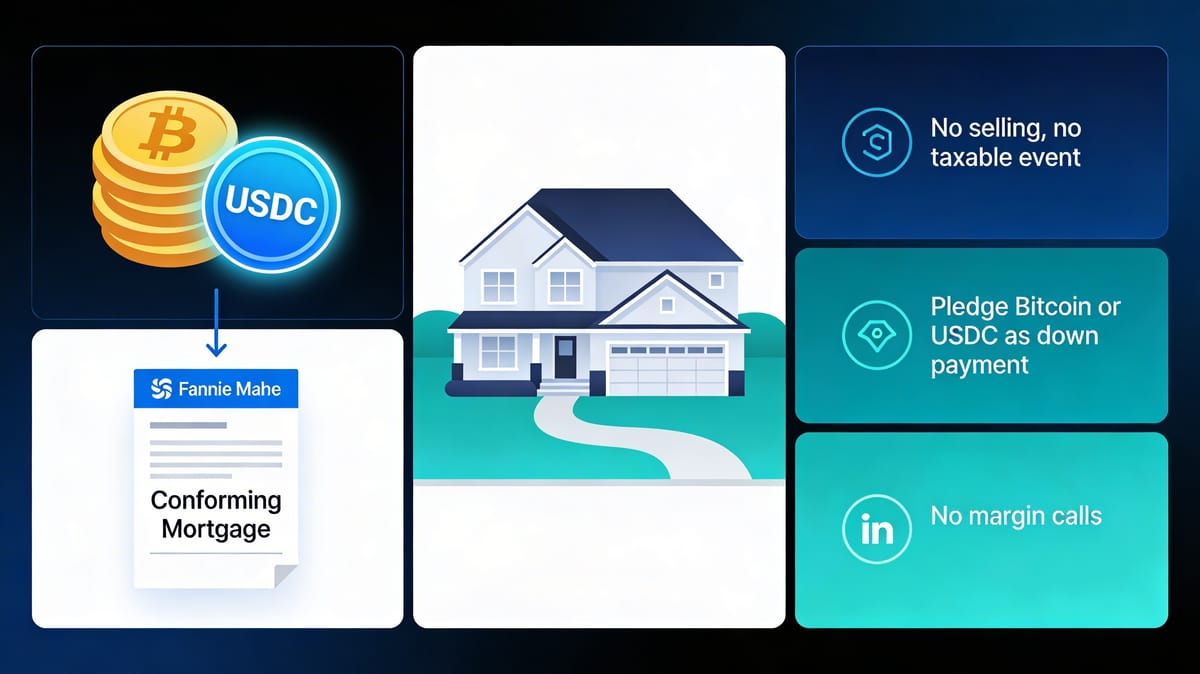
Fannie Mae — the $4.3 trillion government-sponsored mortgage giant — will for the first time accept cryptocurrency-backed mortgages, following a landmark announcement Thursday by mortgage company Better Home & Finance and U.S. crypto exchange Coinbase. The move, originally reported by The Wall Street Journal (subscription required), allows homebuyers to pledge Bitcoin or USDC stablecoin as collateral for a down payment without selling their crypto — a development that could reshape how millions of digital asset holders enter the housing market.
What Was Actually Announced
Better Home & Finance and Coinbase unveiled a new mortgage product Thursday that allows home buyers to pledge their crypto holdings when getting a Fannie-backed mortgage, instead of selling the crypto to make a cash down payment.
Here's how the mechanics work: A home buyer gets a traditional 15- or 30-year Fannie Mae-backed mortgage from Better. Instead of making a cash down payment, the buyer gets a separate loan, backed by either Bitcoin or USDC, a popular stablecoin. The interest rate on both loans would range from comparable to typical Fannie Mae mortgages to 1.5 percentage points higher. Once the crypto assets have been pledged for the down payment, the homeowner can't trade them. If the value of the crypto in the account falls, the mortgage loans aren't affected as long as the owner keeps making monthly payments, said Better CEO Vishal Garg.
As a concrete example, on a $500,000 home, a borrower can pledge $250,000 in Bitcoin and get a $100,000 loan to cover the cash down payment. The crypto stays in custody in Better's Coinbase Prime account for the life of the loan and is returned once the loan is repaid.
An important cost note for buyers to consider: paying interest on a second loan instead of making a cash down payment can increase the overall cost of homeownership significantly.
Coinbase One members who are approved for a loan by Better will also be eligible for a rebate worth 1% of the mortgage value, capped at $10,000.
Why This Matters: The Regulatory Road That Led Here
This isn't the first crypto mortgage offering, but Fannie Mae's involvement could make these types of products far more mainstream. Fannie is backed by the federal government and overseen by the Federal Housing Finance Agency.
That distinction matters enormously because of Fannie's structural role in U.S. housing. Fannie doesn't make loans — it buys mortgages from lenders, packages them to sell to investors and guarantees the payments on them. Because Fannie and Freddie play such a large role in the market, their underwriting standards are widely used across the entire lending industry.
The groundwork for today's announcement was laid in mid-2025. The Trump administration has been generally supportive of the crypto industry. In June, FHFA Director Bill Pulte cited that support in directing Fannie and its sister company, Freddie Mac, to prepare to count crypto as an asset on mortgage applications. That directive required the enterprises to only include cryptocurrency assets that can be evidenced and stored on a U.S.-regulated centralized exchange, and required each enterprise to consider additional risk mitigants including adjustments for market volatility.
The Market Opportunity — and the Current Backdrop
The timing of this product launch arrives against a complicated market backdrop. About 14% of American adults owned cryptocurrencies in 2025, according to Gallup. Bitcoin prices have pulled back significantly in recent months, with prices down more than 40% since peaking in October.
Yet demand for exactly this kind of product is already proven. A 2025 Redfin survey found that almost 13% of millennial and Gen Z recent home buyers sold crypto investments to help fund their down payments. The Better/Coinbase product is designed to serve buyers who want to keep their crypto intact rather than liquidating it.
Max Branzburg, Coinbase's Head of Consumer and Business Products, framed the problem the product solves directly: "A lot of those crypto owners and investors have not been able to become homeowners because they don't want to sell their crypto investments. We haven't really had the best way to service that need."
Coinbase data shows 45% of younger investors own crypto, compared with 18% of older cohorts, suggesting digital assets are becoming a primary store of value for a new generation. With housing affordability near historic lows, the overlap of crypto-rich but cash-poor younger buyers and a market that now accepts digital collateral represents a significant and largely untapped opportunity — though it remains to be seen how widely a higher interest rate product gains adoption.
Not New — But Now Much Bigger
It's worth noting that crypto-backed mortgages have existed in niche channels for years. Milo, a Miami-based fintech company that has offered crypto-backed mortgages since 2022, has more than 100 customers, said CEO Josip Rupena. Milo's customers are similar to foreign home buyers trying to purchase U.S. homes in that they often have significant assets but don't fit into traditional lending boxes.
Rupena's take on the broader trend: "As digital assets become more mainstream, financing products that integrate crypto into real-world use cases will continue to gain traction."
What's new today is institutional scale. Fannie Mae backstops a massive share of American mortgages, and its underwriting decisions ripple across the entire lending industry. When Fannie updates its guidelines, lenders across the country follow. That makes this a potential inflection point for crypto's integration into consumer finance — not a niche fintech experiment, but an institutional green light from the backbone of U.S. mortgage finance. Private lenders were already moving in this direction, with firms like Newrez and Rate having launched non-agency mortgage products that accept crypto for qualification — but Fannie's blessing brings a level of market legitimacy none of those products could claim.
What This Means for the Broader Crypto Market
Today's announcement carries implications well beyond the housing market. For years, one of the central criticisms of cryptocurrency as an asset class has been its limited utility in everyday financial life — that it exists largely as a speculative instrument disconnected from real-world transactions. A Fannie Mae-backed product directly challenges that narrative.
By treating Bitcoin and USDC as legitimate collateral within the most regulated, mainstream corner of American consumer finance, this move signals that digital assets are no longer confined to crypto-native platforms or high-net-worth wealth management channels. They are entering the same system that touches the financial lives of tens of millions of ordinary Americans.
The structural design of the product also matters for the crypto market's long-term trajectory. Because pledged crypto cannot be traded for the life of the loan, widespread adoption could have a meaningful supply-reduction effect on Bitcoin and other eligible assets — locking holdings off exchanges for 15 to 30 years at a time. While the current scale is modest, Bitcoin Magazine noted that Better CEO Vishal Garg estimated the company may have missed up to $40 billion in originations by not offering such products earlier — suggesting the potential pool of demand is substantial.
The stablecoin angle is equally significant. USDC's inclusion as eligible collateral reinforces the growing role of regulated stablecoins in mainstream financial infrastructure — a trend that has accelerating momentum across payments, settlement, and now real estate. As the GENIUS Act works its way through Congress and stablecoin regulation becomes clearer, the groundwork being laid by products like this one could prove foundational.
Other digital assets may eventually follow. According to CNBC's reporting, assets like Ethereum and Solana may be added to the Better/Coinbase product in the future, though no timeline or commitment has been announced. The eligibility criteria established by FHFA — U.S.-regulated exchange listing, volatility-adjusted valuations, liquidity requirements — will serve as the template for which assets gain access to this new on-ramp into American homeownership.
Regulatory Angle: Support and Skepticism
While the Trump administration has been broadly supportive, the proposal has faced meaningful political friction.
Sen. Cynthia Lummis (R-WY) has introduced the 21st Century Mortgage Act, which would require government-sponsored enterprises to consider digital assets when assessing single-family mortgage eligibility and would codify FHFA Director Pulte's plan by prohibiting the forcing of crypto assets into dollars. "We're living in a digital age, and rather than punishing innovation, government agencies must evolve to meet the needs of a modern, forward-thinking generation," Lummis said.
Democratic senators were far less enthusiastic. Senate Banking Committee ranking member Sen. Elizabeth Warren (D-MA), along with Sens. Jeff Merkley, Chris Van Hollen, Mazie Hirono, and Bernie Sanders, wrote: "Expanding underwriting criteria to include the consideration of unconverted cryptocurrency assets could pose risks to the stability of the housing market and the financial system," warning that a borrower using crypto faces an increased risk of not being able to exit a position at a price that would allow them to buffer against mortgage default risk.
The senators also pointed out that FHFA Director Pulte's wife holds up to $2 million in crypto assets, raising allegations of a possible conflict of interest. Their full eight-page letter included detailed questions about how the enterprises will develop their proposals and gather stakeholder feedback.
Key Takeaways
- Confirmed: Better Home & Finance and Coinbase launched the first Fannie Mae-conforming, token-backed mortgage on March 26, 2026, allowing Bitcoin and USDC as down payment collateral — originally reported by The Wall Street Journal.
- Confirmed: Rates range from comparable to standard Fannie Mae loans up to 1.5 percentage points higher; no margin calls; crypto is returned upon loan repayment. Taking a second loan instead of a cash down payment can meaningfully increase the total cost of homeownership.
- Confirmed: About 14% of U.S. adults owned crypto in 2025 (Gallup); nearly 13% of millennial and Gen Z recent buyers already sold crypto to fund down payments (Redfin, 2025).
- Confirmed: FHFA directed Fannie Mae and Freddie Mac in June 2025 to develop crypto-inclusive underwriting proposals — today's product is the first result.
- Speculative: Whether Ethereum, Solana, or other assets will be added to this or similar Fannie Mae-conforming products. No decisions have been announced.
- Watch: The 21st Century Mortgage Act by Sen. Lummis, which could codify and expand this framework into law.
Sources
- The Wall Street Journal — Fannie Mae to Accept Crypto-Backed Mortgages for the First Time — Nicole Friedman & Veronica Dagher · March 26, 2026 (Original Reporting — Subscription Required)
- Better Home & Finance / Coinbase — Official Press Release via Business Wire — March 26, 2026
- Consumer Finance Monitor — FHFA Directs Fannie Mae, Freddie Mac to Develop Plans to Use Cryptocurrency as Assets Without Conversion to Dollars — Ronald K. Vaske & John D. Socknat, Ballard Spahr LLP · August 14, 2025
- CNBC — Fannie Mae Accepts First Crypto-Backed Mortgage Product — March 26, 2026
- HousingWire — Better and Coinbase Launch Token-Backed Mortgage Down Payment — Flávia Furlan Nunes · March 26, 2026
- CoinDesk — Coinbase, Fannie Mae Bring Crypto-Backed Mortgages to Home Buyers — March 26, 2026
- Bloomberg — Crypto Enters the Mortgage Market Via Fannie Mae-Eligible Loans — March 26, 2026
- Unchained Crypto — Fannie Mae Will Accept Crypto-Backed Mortgages for the First Time — March 26, 2026
- Bitcoin Magazine — Buy a Home With Bitcoin: Coinbase, Fannie Mae — March 26, 2026
- BeInCrypto — Fannie Mae Crypto Mortgage Reserves After FHFA Directive — March 26, 2026
DISCLAIMER: This newsletter is for informational purposes only and does not constitute investment advice, advertising, or a recommendation to buy, sell, or hold any securities. This content is not sponsored by or affiliated with any of the mentioned entities. Investments in cryptocurrencies or other financial assets carry significant risks, including the potential for total loss, extreme volatility, and regulatory uncertainty. Past performance is not indicative of future results. Always consult a qualified financial professional and conduct thorough research before making any investment decisions.