Coinbase Tells Crypto Industry to Stand Down on Stablecoin Yield Fight Despite Banking Victory
Coinbase tells crypto industry to stand down on stablecoin yield fight, calling Senate draft 'least horrible language' despite banking victory. Will only oppose if terms worsen. DeFi provisions spark separate concerns. 48-hour amendment deadline looms.
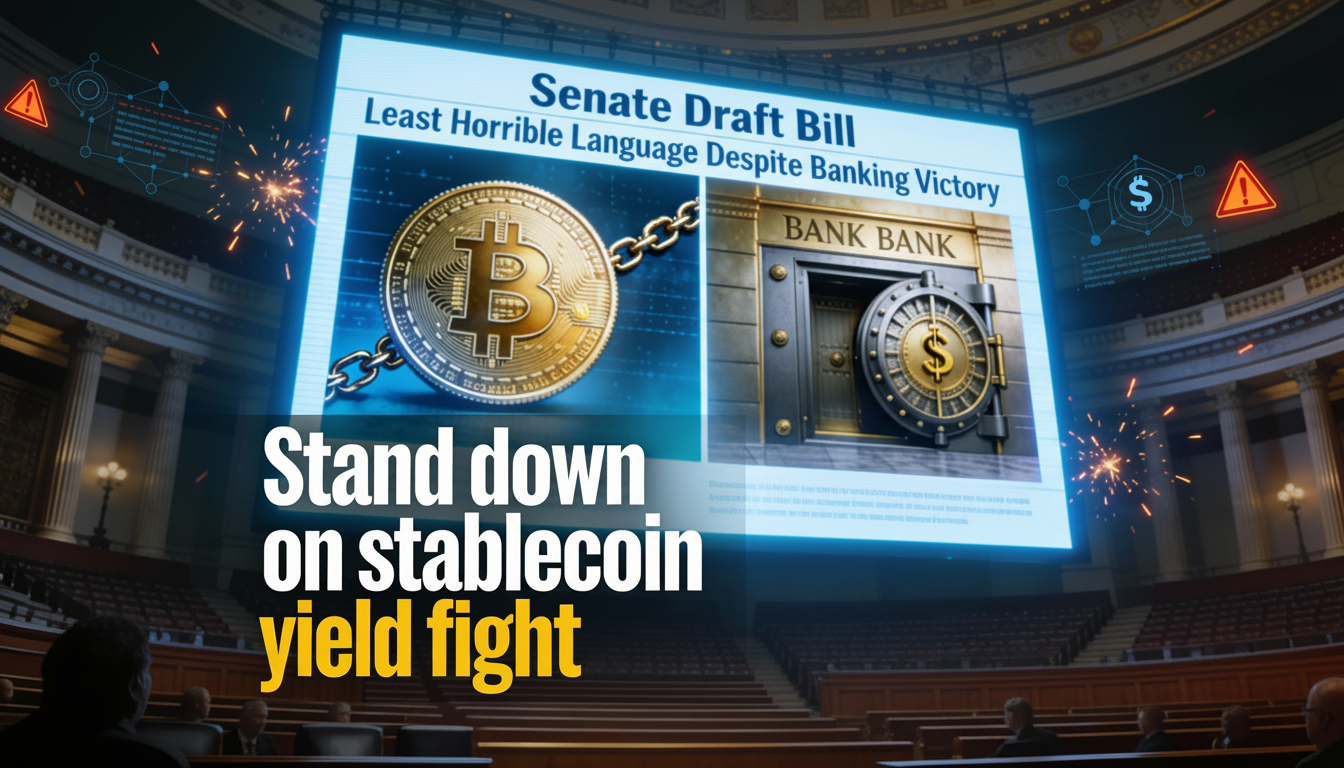
In a surprising strategic move, Coinbase is urging the cryptocurrency industry to accept contentious stablecoin yield restrictions in the Senate Banking Committee's Digital Asset Market Clarity Act, calling it "the least horrible language they'd still support" as lobbyists face a 48-hour deadline to influence the bill before Thursday's markup.
🚨NEW: Yield update: Banks may have won this round on stablecoin yield. The latest draft (page 189) says companies cannot pay interest just for holding balances. You can earn rewards, but only if they’re tied to opening an account or activity like making transactions, staking,… https://t.co/Df3u3Ar3cM
— Eleanor Terrett (@EleanorTerrett) January 13, 2026
Coinbase's Strategic Retreat
According to Sander Lutz, director of policy at Inca Digital and verified crypto policy reporter, "Coinbase is telling the crypto industry to stand down on opposing the stablecoin yield language for now, a source with direct knowledge tells me."
The source characterized Coinbase's position as acknowledging "it's a win for the banks, but it's basically the least horrible language they'd still support." However, Coinbase's stance comes with a caveat: "If it gets worse—if banking lobby extracts even more changes—that posture would change."
This represents a calculated concession from one of crypto's most powerful lobbying forces, suggesting the industry may be prioritizing getting some regulatory framework passed over fighting for ideal terms.
Key update: Coinbase is telling the crypto industry to stand down on opposing the stablecoin yield language for now, a source with direct knowledge tells me. Saying it's a win for the banks but it's basically the least favorable language they'd still support. If it gets worse--if… https://t.co/6DgoEz0a1W
— Sander Lutz (@s_lutz95) January 13, 2026
What Banks Won in Section 404
The legislative text reveals that Section 404, titled "Preserving Rewards for Stablecoin Holders," prohibits digital asset service providers from paying "any form of interest or yield (whether in cash, tokens, or other consideration) solely in connection with the holding of a payment stablecoin."
Eleanor Terrett, a verified crypto reporter, clarified that the draft language means "companies cannot pay interest just for holding balances" but can provide rewards if they're "tied to opening an account or activity like making transactions, staking, providing liquidity, putting up collateral, or participating in network governance."
The bill includes specific carve-outs allowing "activity-based" rewards for:
- Transactions, payments, transfers, conversions, remittances, or settlements
- Using a wallet, account, platform, application, protocol, or network
- Participation in loyalty, promotional, subscription, or incentive programs
- Acceptance, settlement, or acquiring activity
- Providing liquidity or collateral
- Governance, validation, staking, or other ecosystem participation
Industry Concerns About "Murky Language"
Despite Coinbase's acceptance, other industry participants remain uneasy. Lutz reported that one crypto policy leader described the yield language as "too cute," suggesting concern that the attempt to balance competing interests may create compliance uncertainty.
The worry centers on how regulators would interpret the activity-based reward exceptions. While the language appears to create workable loopholes for crypto companies to offer incentives, the exact boundaries remain undefined—potentially creating legal risk for companies trying to structure compliant reward programs.
The Unexpected DeFi Bombshell
Beyond stablecoin yields, Lutz highlighted a second major concern: Title III of the draft introduces "a massive new section on DeFi (Title III) that the crypto lobby wasn't expecting." This section includes new definitions and requirements that industry participants fear could capture a broader range of decentralized finance activities than anticipated.
The draft distinguishes between "decentralized finance trading protocols" and "non-decentralized finance trading protocols," with Section 301 requiring rulemaking on how existing securities intermediary requirements and Bank Secrecy Act requirements apply to protocols that have elements of central control despite operating on distributed ledgers.
According to Lutz, this section is "full of new definitions and (again) murky language that industry fears could rope a lot of DeFi into regulation." One top crypto lobbyist told Lutz that "a decent amount of industry is 'very upset' over this."
The 48-Hour Scramble
Industry participants have until 5pm today to submit feedback into amendments before Thursday's committee markup. This compressed timeline comes as lobbyists are described as "tired and wired" after an intense period of negotiations.
Lutz's sources paint a pessimistic picture of the bill's ultimate prospects, with current sentiment described as "NGMI" (Not Gonna Make It). This assessment stems not only from the specific stablecoin and DeFi provisions but also from "enduring disagreement on ethics/conflict of interest language between Senate Dems and White House/GOP."
Why Coinbase's Position Matters
Coinbase's decision to urge industry acceptance rather than opposition carries significant weight. As one of the largest cryptocurrency exchanges and a major player in the stablecoin market, Coinbase wields considerable lobbying influence in Washington.
The company's strategic calculation appears to prioritize legislative progress over perfect outcomes. By accepting the stablecoin yield restrictions now, Coinbase may be betting that:
- The activity-based exceptions provide sufficient flexibility for their business model
- Further banking lobby victories could result in worse terms, making the current language a defensible compromise
- Getting any comprehensive crypto framework passed is more valuable than holding out for ideal provisions
- The bill's prospects are uncertain enough that fighting over details could jeopardize the entire effort
However, the "If it gets worse" qualifier suggests Coinbase is monitoring for any further concessions to banking interests during the amendment process.
What This Means for Stablecoin Business Models
The prohibition on direct yield payments represents a significant constraint on stablecoin issuers' business models. Traditional banks have long argued that allowing non-bank stablecoin issuers to pay interest constitutes regulatory arbitrage—giving crypto companies banking-like capabilities without full banking oversight or consumer protections.
For stablecoin issuers, the framework would mean:
- No direct interest payments on holdings (similar to non-interest-bearing checking accounts)
- Compensation through activity-based rewards programs instead
- Need to clearly structure rewards around measurable activities rather than passive holding
- Potential compliance uncertainty around where the line falls between prohibited "yield" and permissible "activity rewards"
For stablecoin users:
- Shift from predictable yield to variable activity-based rewards
- Incentives to actively use stablecoins rather than hold them passively
- Potential for creative reward structures (cashback, loyalty points, transaction rebates)
- Less direct competition with traditional bank deposit interest
The DeFi Regulatory Framework Takes Shape
Title III's provisions on decentralized finance represent an attempt to create legal distinctions between truly decentralized protocols and those with centralized control elements. The draft defines "decentralized ledger finance trading protocols" as systems where transactions execute "in accordance with an automated rule or algorithm that is predetermined and non-discretionary" and "without reliance on a person other than the user to maintain custody or control."
"Non-decentralized finance trading protocols" would include systems where "a person or group of persons under common control or acting pursuant to an agreement to act in concert has the authority, directly or indirectly, through any contract, arrangement, understanding, relationship, or otherwise, to control or materially alter the functionality, operation, or rules of consensus or agreement of the decentralized ledger finance trading protocol."
This creates a regulatory framework where truly autonomous, immutable protocols might receive different treatment than protocols with upgradeable smart contracts or governance tokens that enable collective control.
Timeline and Prospects
It's important to note: This is a draft bill that has not been passed or enacted. The provisions discussed could change significantly during Thursday's markup process, and the bill would still need to pass the full Senate, reconcile with any House version, and be signed into law before taking effect.
The immediate timeline:
- Today by 5pm: Final deadline for industry feedback on amendments
- Thursday: Senate Banking Committee markup where amendments will be debated and voted on
- Unknown: Full Senate vote timing if the bill clears committee
- Unknown: House reconciliation process if Senate passes a version
Multiple sources indicate skepticism about the bill's ultimate prospects, citing partisan disagreements on provisions beyond the crypto-specific elements.
Industry Split on Strategy
Coinbase's position appears to represent one camp within the crypto industry—those willing to accept imperfect regulatory clarity as better than continued uncertainty. However, Lutz's reporting suggests other industry participants, particularly those focused on DeFi, remain resistant to what they view as overly broad regulatory language.
This split reflects a broader strategic debate within crypto: whether to pursue incremental regulatory wins that involve compromises with traditional finance, or to hold out for more crypto-friendly frameworks even if that means prolonged regulatory uncertainty.
The next 48 hours will reveal which approach prevails—and whether Coinbase's call for industry restraint carries the day.
Key Takeaways
- Coinbase urging crypto industry to accept stablecoin yield restrictions as "least horrible language"
- Source says Coinbase will only oppose if banking lobby extracts more concessions
- Draft prohibits direct interest on stablecoin holdings but allows activity-based rewards
- Title III introduces unexpected DeFi regulatory framework with definitions distinguishing protocol types
- Industry concerned about "murky language" creating compliance uncertainty
- 48-hour window for amendments before Thursday markup
- Sources express pessimism about bill's ultimate prospects due to partisan disagreements
Coinbase's strategic retreat on stablecoin yields signals a pragmatic shift in crypto industry lobbying—but with a clear red line if banks push for further victories.
DISCLAIMER: This newsletter is for informational purposes only and does not constitute investment advice, advertising, or a recommendation to buy, sell, or hold any securities. This content is not sponsored by or affiliated with any of the mentioned entities. Investments in cryptocurrencies or other financial assets carry significant risks, including the potential for total loss, extreme volatility, and regulatory uncertainty. Past performance is not indicative of future results. Always consult a qualified financial professional and conduct thorough research before making any investment decisions.
Sources
- Digital Asset Market Clarity Act Draft - Senate Banking Committee
- Sander Lutz on X - Coinbase Industry Position and Source Updates
- Eleanor Terrett on X - Stablecoin Yield Language Analysis