CFTC Launches Historic Crypto Pilot: Bitcoin, Ethereum, and Stablecoins Now Approved as Derivatives Collateral
The CFTC just opened the door to crypto's biggest mainstream moment yet—Bitcoin, Ethereum, and stablecoins can now function as collateral in America's $700+ trillion derivatives markets under federal oversight, marking a historic shift from alternative asset to essential financial infrastructure.

The U.S. Commodity Futures Trading Commission made a groundbreaking announcement today that could fundamentally reshape how cryptocurrency integrates with traditional finance. Acting Chairman Caroline Pham launched a digital assets pilot program that allows Bitcoin, Ethereum, and payment stablecoins like USDC to be used as collateral in America's $700+ trillion derivatives markets—marking crypto's most significant regulatory validation to date.
What Was Actually Announced
The CFTC's pilot program, announced Monday, December 8, 2025, establishes clear regulatory guardrails for three specific digital assets to function as collateral in derivatives trading: Bitcoin (BTC), Ethereum (ETH), and payment stablecoins including USDC. According to the official CFTC press release, the program includes enhanced monitoring and reporting requirements designed to protect customer assets while enabling innovative market structures.
Critically, the CFTC also withdrew Staff Advisory No. 20-34, outdated guidance from 2020 that had effectively blocked crypto assets from being used as customer collateral. The agency stated that substantial developments in digital asset markets and the passage of the GENIUS Act rendered the old restrictions obsolete.
Why This Is Massive for Crypto Adoption
The derivatives market represents one of the largest financial markets globally, with over $700 trillion in notional outstanding positions as of late 2024. For context, that's roughly double the world's entire GDP. Allowing crypto assets to serve as collateral in even a fraction of these markets opens unprecedented institutional access.
"For years I have said that collateral management is the 'killer app' for stablecoins in markets," Acting Chairman Pham stated. "Today, we are finally moving forward on this work. The CFTC continues to move full speed ahead at the cutting edge of responsible innovation."
The Innovation Factor: 24/7 Settlement and Capital Efficiency
Traditional derivatives markets operate on banking hours, creating settlement delays and liquidity constraints during evenings, weekends, and holidays. Tokenized collateral changes this equation entirely. Circle President Heath Tarbert emphasized that using stablecoins like USDC as collateral enables continuous risk management: "Using trusted stablecoins like USDC as collateral will lower costs, reduce risk, and unlock liquidity across global markets 24/7/365."
Coinbase Chief Legal Officer Paul Grewal noted that tokenized collateral can unlock U.S. derivatives markets and position America ahead of global competition. The near-real-time margin settlement capability mitigates settlement-failure and liquidity-squeeze risks that plague traditional systems.
How This Differs From Previous Crypto Market Access
This isn't just another exchange listing or ETF approval. The CFTC pilot fundamentally integrates crypto into the backbone of regulated financial infrastructure. Market participants can now use Bitcoin, Ethereum, and stablecoins the same way they've historically used cash or U.S. Treasuries—as margin to secure derivatives positions.
Jack McDonald, Senior Vice President of Stablecoins at Ripple, explained the significance: "This CFTC initiative is an important step toward integrating stablecoins into the heart of regulated financial markets. Establishing clear rules for valuation, custody, and settlement will give institutions the certainty they need, while guardrails on reserves and governance will build trust and resilience."
The pilot includes specific provisions for:
- Enhanced monitoring: Three-month initial reporting periods with CFTC oversight
- Custody standards: Clear requirements for digital asset custodians
- Valuation frameworks: Consistent approaches to pricing 24/7 assets
- Settlement finality: Legal clarity on blockchain-based transactions
Regulatory Foundation: The GENIUS Act Connection
This initiative builds directly on the GENIUS Act (Guiding and Establishing National Innovation for U.S. Stablecoins), which President Trump signed into law in July 2025. The legislation established the first comprehensive federal framework for payment stablecoins, creating regulatory clarity that this pilot program now operationalizes.
The timing isn't coincidental. Acting Chairman Pham's announcement explicitly stated the pilot implements recommendations from the President's Working Group on Digital Asset Markets report, part of the administration's broader "America's Golden Age of Crypto" initiative.
XRP and Ripple: Positioned at the Intersection
While the pilot specifically mentions Bitcoin, Ethereum, and payment stablecoins, Ripple's ecosystem stands uniquely positioned to benefit from this regulatory evolution. The company has been deeply involved in the CFTC's consultation process, with participation in the February 2025 Crypto CEO Forum where tokenized collateral frameworks were discussed.
RLUSD: Ripple's Institutional Stablecoin Play
Ripple's RLUSD stablecoin, issued by Standard Custody & Trust Company and regulated by New York's Department of Financial Services, appears purpose-built for this exact use case. The stablecoin recently surpassed $1 billion in market capitalization and maintains full backing through U.S. Treasury bills, government money-market funds, and FDIC-insured deposits with monthly attestations.
Industry observers note that RLUSD's compliance-first design positions it as an ideal institutional bridge between crypto and Wall Street. With the derivatives market representing over $600 trillion in value, even modest adoption of RLUSD as collateral could drive substantial demand.
XRP's Emerging Infrastructure Role
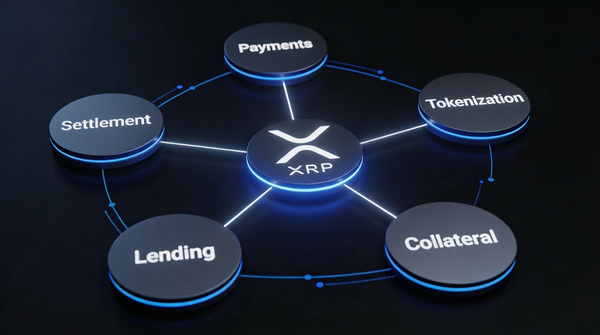
Separately but relatedly, XRP recently achieved its first CFTC-regulated spot listing on Bitnomial, offering a full suite of products including spot, futures, perpetuals, and options under federal oversight. Market analyst Diana highlighted that XRP is now approved as trading collateral, allowing it—alongside RLUSD—to be used as margin similar to Treasuries or stablecoins.
This dual positioning creates interesting dynamics. Every RLUSD transaction on the XRP Ledger incurs small XRP network fees that are burned, decreasing supply over time. As stablecoin flows increase, liquidity deepens, potentially creating sustained demand for XRP beyond speculative trading.
Broader Market Implications
The crypto derivatives market itself has grown explosively, with 2025 annual trading volumes approaching $28 trillion—dwarfing spot trading and accounting for approximately 76% of total cryptocurrency trading volume. Now, traditional derivatives participants can access this liquidity while maintaining regulatory compliance.
Kris Marszalek, Co-Founder and CEO of Crypto.com, called the announcement a historic milestone: "Today marks an important milestone in the history of the crypto industry—we have been given regulatory certainty for the future. The CFTC guidance on tokenized collateral is the latest example of Acting Chairman Pham delivering on the promise of President Trump to make the United States the 'crypto capital of the world.'"
What Happens Next
The CFTC pilot includes a three-month initial monitoring period during which registered clearing intermediaries can accept Bitcoin, Ethereum, and USDC as collateral while the agency tracks reporting and market dynamics. Based on these results, the program could expand to include additional digital assets and broader market participation.
The agency previously sought public input on tokenized collateral frameworks, receiving feedback from major financial institutions, clearing organizations, and crypto firms through October 20, 2025. Today's announcement represents the fruition of that collaborative regulatory process.
The Mainstream Adoption Thesis
Critics have long argued that cryptocurrency lacks real-world utility beyond speculation. The CFTC pilot directly challenges that narrative. When banks, hedge funds, and institutional traders can use crypto assets as functional collateral in the world's largest financial markets—subject to federal oversight and consumer protection—it validates crypto as legitimate financial infrastructure rather than merely an alternative asset class.
Paolo Ardoino, CEO of Tether, framed it as a competitive imperative: "The decision to recognize stablecoins as part of U.S. market infrastructure is an important step toward strengthening the U.S.'s leadership in global finance and in ensuring its markets remain competitive."
The initiative also addresses persistent concerns about crypto market fragmentation. By creating clear on-ramps between traditional derivatives and digital assets, the pilot could accelerate capital flows and reduce the friction that's historically limited institutional participation.
Conclusion: From Experiment to Infrastructure
The CFTC's digital assets pilot represents more than regulatory approval—it's institutional recognition that tokenized collateral and blockchain-based settlement offer tangible improvements over legacy systems. By allowing Bitcoin, Ethereum, and stablecoins to function as derivatives collateral under federal oversight, U.S. regulators are betting that crypto's technical advantages outweigh its risks when properly managed.
For XRP and Ripple, the timing couldn't be better. With RLUSD positioned as a compliant institutional stablecoin and XRP gaining CFTC-regulated exchange listings, the ecosystem appears architected for precisely this moment. Whether measured in improved capital efficiency, 24/7 market access, or reduced settlement risk, the pilot's success could determine whether crypto becomes essential financial plumbing or remains a parallel system.
The next three months will provide critical data on market adoption, operational challenges, and the viability of crypto collateral at scale. If the pilot succeeds, December 8, 2025 may be remembered as the day crypto definitively moved from the margins to the mainstream of American finance.
DISCLAIMER: This newsletter is for informational purposes only and does not constitute investment advice, advertising, or a recommendation to buy, sell, or hold any securities. This content is not sponsored by or affiliated with any of the mentioned entities. Investments in cryptocurrencies or other financial assets carry significant risks, including the potential for total loss, extreme volatility, and regulatory uncertainty. Past performance is not indicative of future results. Always consult a qualified financial professional and conduct thorough research before making any investment decisions.
Sources
- CFTC Official Press Release - Acting Chairman Pham Launches Tokenized Collateral and Stablecoins Initiative
- The Block - CFTC Launches Tokenized Initiative
- CoinDesk - BTC, ETH, USDC as Collateral in CFTC Crypto Pilot
- Bitcoin Ethereum News - U.S. Derivatives Markets Embrace Crypto Collateral
- Davis Wright Tremaine - Tokenized and Stablecoins Initiative Analysis
- Chambers Practice Guide - Derivatives 2025 USA
- CoinPaper - XRP Makes History with CFTC-Regulated Listing
- Bit2Me - Ripple in the Institutional Game: RLUSD as Wall Street Bridge
- 24/7 Wall St. - RLUSD Stablecoin Hits $1 Billion
- Coinlaw - Cryptocurrency Derivatives Market Statistics 2025
- Mondovisione - Acting CFTC Chairman Announces Digital Assets Pilot