Agent Commerce Has Arrived on the XRP Ledger — Here's What That Means
Agent commerce just landed on the XRP Ledger. Virtuals Protocol and t54.ai are enabling AI agents to transact autonomously — escrowed jobs, on-chain verification, and native XRP and RLUSD payments. Here's what it means and why it matters.
This morning, t54.ai posted a straightforward announcement that carries significant weight for anyone watching where AI and blockchain are heading: agent commerce is coming to the XRPL. Virtuals Protocol confirmed from their own account that they are powering it, and RippleX's official developer account amplified the news within hours.
What that means in practice: using t54's x402 facilitator, AI agents can now natively pay in XRP and RLUSD directly on the XRP Ledger — no human approval required, no billing account, no subscription friction.
What Was Actually Announced
The announcement, posted March 19, 2026, confirmed three specific capabilities now live on the XRPL:
- Escrowed jobs — payment is locked in a smart contract and released only when work is completed and verified
- Verification through evaluators — a neutral third-party agent or smart contract confirms delivery before funds move
- Programmable settlement — the entire payment lifecycle executes on-chain without human intervention
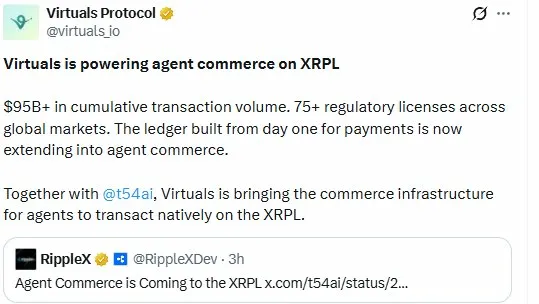
Virtuals Protocol noted in their post that the platform carries $95B+ in cumulative transaction volume and holds 75+ regulatory licenses across global markets — describing the XRPL as "the ledger built from day one for payments" now extending into agent commerce.
This is not a roadmap item. According to t54.ai's post, agents can already use the x402 facilitator to pay natively in XRP and RLUSD today.
Why the x402 Protocol Matters Here
x402 was developed by Coinbase and revives HTTP's long-dormant 402 "Payment Required" status code, turning it into a programmable payment rail for autonomous AI systems. When an agent needs a resource or service, the server returns a 402 response, the agent evaluates the cost, executes a micro-payment on-chain, and resubmits — all within a single automated exchange, with sub-2-second settlement and transaction costs around $0.0001.
The problem x402 solves is straightforward. Traditional payment systems were designed for humans. An AI agent cannot open a bank account, hold a credit card, or go through a billing approval workflow. As Amazon Web Services recently outlined, agents are capable of doing the work but stop at the point of payment. x402 removes that stop.
t54's open-source x402-secure SDK adds an identity and security layer on top of the protocol, and their XRPL facilitator specifically enables XRP and RLUSD as the native settlement currency for those agent payments.
What Virtuals Protocol Brings to the Table
Virtuals Protocol is not a new player. Its Agent Commerce Protocol (ACP) — the infrastructure behind today's announcement — uses smart contract-based escrow, cryptographic verification of agreements, and an independent evaluation phase to enable trustless commerce between AI agents. The whitepaper describes it as a foundation of trust through technology rather than third-party intermediaries.
The three-phase structure matters: a request phase establishes compatibility, a transaction phase locks both payment and deliverables in escrow, and an evaluation phase confirms the work was done before any funds move. Evaluator agents can be AI systems, ZK verifier smart contracts, or multisigs — the protocol only requires that someone calls complete or reject.
Bringing this architecture natively to the XRPL — where settlement takes 3-5 seconds and transaction costs are fractions of a cent — is a meaningful step toward an operational agent economy rather than a theoretical one.
What This Means for Ripple and XRP
This announcement does not exist in isolation. It follows a $5 million seed round t54 closed on February 25, 2026, co-led by Anagram, PL Capital, and Franklin Templeton — with Ripple as a strategic investor. Ripple's participation was not passive. Markus Infanger, Senior Vice President of RippleX, stated that automated systems are playing a role as entities participating in economic activities, not only tools, and that financial infrastructure needs to adapt accordingly. Ripple President Monica Long wrote on X that as autonomous agents begin managing real capital, trust infrastructure becomes a foundational piece of the equation.
For the XRPL specifically, the implications are concrete:
Ripple's 2026 roadmap is already oriented around making XRPL an institutional DeFi-friendly chain — with permissioned domains, credential-based access, privacy-preserving transfers, and the XLS-65/66 lending protocol. Agent commerce infrastructure from Virtuals and t54 slots directly into that direction. XRP's role as the settlement and bridge asset on the ledger means that agent transactions routing through XRPL consume XRP in fees and use RLUSD (Ripple's regulated stablecoin) as the payment currency — both of which tie network activity back to native assets.
The x402 facilitator also allows agents to already pay for digital services using XRP. That creates a new demand surface for XRP that doesn't depend on speculative trading but on actual utility — agents paying for API calls, compute resources, and task outputs in real time.
What Is Still Speculative
A few things worth separating from confirmed facts: the scale at which agent commerce on XRPL will grow, the degree to which this drives XRP price, and how quickly institutional adoption follows developer activity are all open questions.
Industry observers, including analysts cited by Coindoo, suggest that agentic AI could drive up to $3 trillion in corporate productivity by 2026, and that autonomous systems could handle more than 40% of enterprise workflows — but those projections come from broader market analysis, not confirmed deployment data. The stronger consensus, as the same report notes, is that infrastructure buildout — identity, compliance, and automated settlement — will determine whether this moves from experimentation to mainstream. The Virtuals-t54-XRPL integration is a piece of that infrastructure. Whether it becomes load-bearing depends on developer adoption and institutional uptake, neither of which is guaranteed.
The Broader Picture
This announcement lands on a ledger that was designed from the start around fast, cheap, final settlement — properties that matter more for machine-to-machine commerce than almost any other use case. Human-to-human payments can tolerate two-day ACH windows. Agent-to-agent payments cannot.
A YouGov study found that 42% of US consumers would allow AI agents to make purchases on their behalf if it secured the lowest price. Keyfactor research shows that 86% of cybersecurity professionals believe autonomous systems should carry unique digital identities. The infrastructure to support both of those preferences — identity, trust, and payment rails — is what t54 and Virtuals are building together, and what the XRPL is now hosting.
RippleX's decision to amplify this announcement from their official developer account is not incidental. It signals that this is part of what the XRP Ledger is becoming in 2026.
Sources
- t54.ai on X — Agent Commerce Is Coming to the XRPL (March 19, 2026)
- Virtuals Protocol on X — Virtuals Is Powering Agent Commerce on XRPL (March 19, 2026)
- RippleX on X — Agent Commerce Is Coming to the XRPL (March 19, 2026)
- Virtuals Protocol — Agent Commerce Protocol Whitepaper
- x402 Protocol Whitepaper — Coinbase / x402.org
- CryptoNinjas — t54 Secures $5M Seed as Ripple, Franklin Templeton Back AI Agent Finance (February 26, 2026)
- SQ Magazine — Ripple Invests in AI Startup to Power XRP Payments
- CoinDesk — XRP at Center as Ripple Lays Out Institutional DeFi Blueprint for XRPL (February 6, 2026)
- Amazon Web Services — x402 and Agentic Commerce: Redefining Autonomous Payments in Financial Services (March 2026)
- Coindoo — Ripple Backs $5M AI Funding Round to Power Automated Economy
- MEXC — What Is Virtuals Protocol ($VIRTUAL)? x402 Agent Commerce Protocol and AI Agent Economy
- Bitrue — Exploring the ERC-8183 Standard for AI Transactions from Virtuals and the Ethereum Foundation
DISCLAIMER: This newsletter is for informational purposes only and does not constitute investment advice, advertising, or a recommendation to buy, sell, or hold any securities. This content is not sponsored by or affiliated with any of the mentioned entities. Investments in cryptocurrencies or other financial assets carry significant risks, including the potential for total loss, extreme volatility, and regulatory uncertainty. Past performance is not indicative of future results. Always consult a qualified financial professional and conduct thorough research before making any investment decisions.